Dans la collection de goldgrube
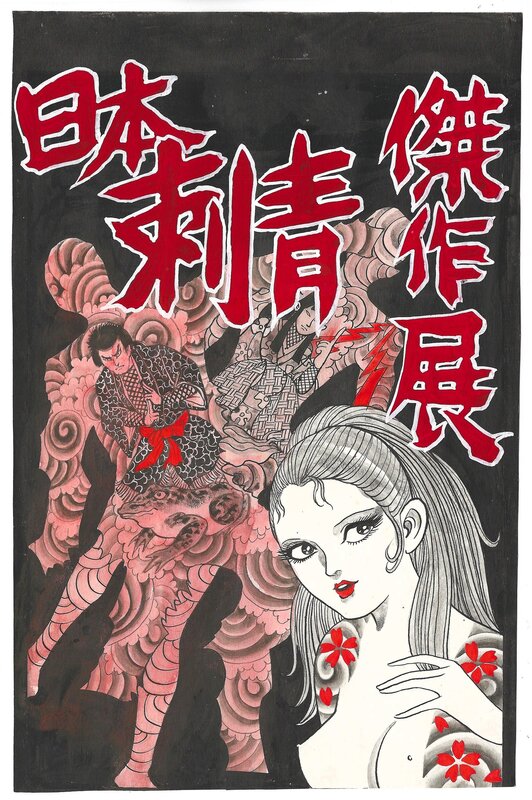
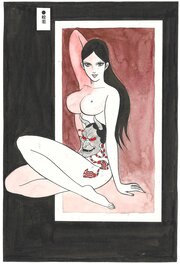
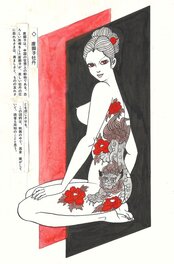
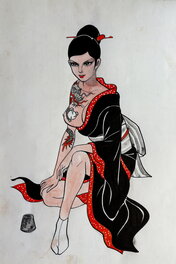
Hanketsuji Rika | Delinquent Girl's Deadly Tears | Sex & Fury | Le Lezard Noir
Encre de Chine
22 x 30 cm (8.66 x 11.81 in.)
Ajoutée le 05/01/2026
Lien copié dans le presse-papier !
Description
First publication by Hope Publishing, Japan (1977)
French publication in Sex & Fury (Le Lezard Noir, 2014)
Tanaka Kiyomi, a.k.a. Bonten Tarō (1929–2008), was a Japanese mangaka, tattoo artist, painter, designer, and wide-ranging cultural figure. Bonten Tarō functioned as his public artistic identity, but he worked under several other names depending on context; Ishii Kiyomi for shōjo manga and Hori-Kiyo as a tattoo artist are the most well known.
His early artistic work included kamishibai, which he studied under Kata Kōji, the creator of Golden Bat. This background strongly influenced his later work in manga and is often cited as a source for the early use of the term “gekiga” when adult-oriented story manga began to appear.
His manga career began in the kashihon (rental book) era, placing him among the pioneering generation of postwar manga artists.
He worked across boys’ manga, girls’ manga, and gekiga, creating sensational and socially charged narratives.
His best-known works include The Tale of a Delinquent Girl: Rika the Half-Blooded Child and The Tale of a Delinquent Sister: Inoshika Ochō. During this period, he was friends with mangaka such as Shigeru Mizuki and Sanpei Shirato, contributing to a network of artists who shaped postwar alternative and adult manga.
French publication in Sex & Fury (Le Lezard Noir, 2014)
Tanaka Kiyomi, a.k.a. Bonten Tarō (1929–2008), was a Japanese mangaka, tattoo artist, painter, designer, and wide-ranging cultural figure. Bonten Tarō functioned as his public artistic identity, but he worked under several other names depending on context; Ishii Kiyomi for shōjo manga and Hori-Kiyo as a tattoo artist are the most well known.
His early artistic work included kamishibai, which he studied under Kata Kōji, the creator of Golden Bat. This background strongly influenced his later work in manga and is often cited as a source for the early use of the term “gekiga” when adult-oriented story manga began to appear.
His manga career began in the kashihon (rental book) era, placing him among the pioneering generation of postwar manga artists.
He worked across boys’ manga, girls’ manga, and gekiga, creating sensational and socially charged narratives.
His best-known works include The Tale of a Delinquent Girl: Rika the Half-Blooded Child and The Tale of a Delinquent Sister: Inoshika Ochō. During this period, he was friends with mangaka such as Shigeru Mizuki and Sanpei Shirato, contributing to a network of artists who shaped postwar alternative and adult manga.
Commentaire
At the same time, Bonten Tarō became a central figure in the transformation of Japanese tattoo culture. He devoted himself to dismantling the association between tattoos and criminality, presenting tattoos as a form of “skin art” or “skin illustration,” understood as the decoration of the human body with images.
He pointed out the historical distinction between penal tattooing and decorative irezumi or bunshin, and in the 1970s he researched Western multicolour tattooing and introduced full-colour techniques into Japanese tattoo practice.
He was one of the first in Japan to adopt and refine design tracing, transfer methods, and electric tattoo machines. These innovations led to him being treated as a heretic by traditional tattoo artists, but they later became standard practice, and he is now regarded as a pioneer of modern Japanese tattooing.
Bonten Tarō actively pursued public visibility, appearing on television and in magazines and giving demonstrations of machine tattooing as part of his effort to popularize the medium.
His creative activities extended far beyond manga and tattooing and included painting, illustration, fashion design, novel writing, theatre direction, film work, acting, singing, and even restaurant management.
He developed the concept of “tattoo fashion,” staged a fashion show in Ginza, and in 1972 designed the ring robe for Cassius Clay (Muhammad Ali) for his fight at the Nippon Budokan in Tokyo.
From the 1980s onward, he led the Bonten Theatre Company, staging works drawn from his own experiences as a former kamikaze unit member and using theatre as a platform to criticize the injustice of war. Bonten Tarō supported and trained large numbers of young artists, housing more than twenty apprentices and instructing them not only in tattooing but also in painting, manga, and music.
He pointed out the historical distinction between penal tattooing and decorative irezumi or bunshin, and in the 1970s he researched Western multicolour tattooing and introduced full-colour techniques into Japanese tattoo practice.
He was one of the first in Japan to adopt and refine design tracing, transfer methods, and electric tattoo machines. These innovations led to him being treated as a heretic by traditional tattoo artists, but they later became standard practice, and he is now regarded as a pioneer of modern Japanese tattooing.
Bonten Tarō actively pursued public visibility, appearing on television and in magazines and giving demonstrations of machine tattooing as part of his effort to popularize the medium.
His creative activities extended far beyond manga and tattooing and included painting, illustration, fashion design, novel writing, theatre direction, film work, acting, singing, and even restaurant management.
He developed the concept of “tattoo fashion,” staged a fashion show in Ginza, and in 1972 designed the ring robe for Cassius Clay (Muhammad Ali) for his fight at the Nippon Budokan in Tokyo.
From the 1980s onward, he led the Bonten Theatre Company, staging works drawn from his own experiences as a former kamikaze unit member and using theatre as a platform to criticize the injustice of war. Bonten Tarō supported and trained large numbers of young artists, housing more than twenty apprentices and instructing them not only in tattooing but also in painting, manga, and music.
6 commentaires
Pour laisser un commentaire sur cette œuvre, veuillez vous connecter