Dans la collection de goldgrube
Description
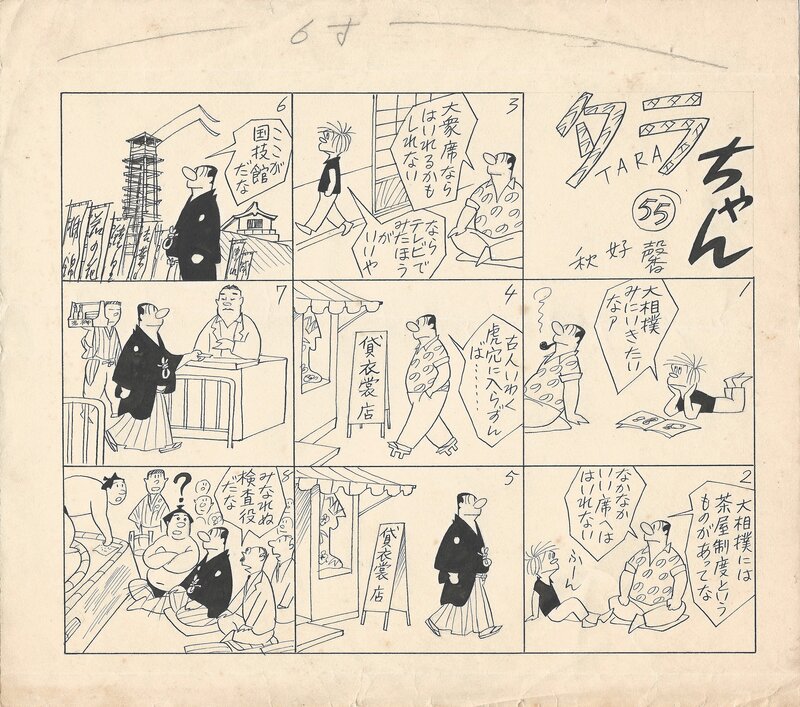
Kaoru Akiyoshi (秋好馨, 1912–1989) was a major figure in mid-20th-century Japanese newspaper manga and one of the defining creators of long-running 4-panel comics during the Shōwa period.
This 'sunday' gag highlights Japan's moral talk and actual expectations, seen through Akiyoshi's sincere eyes ... pointing out extravagance, waste and luxury !
This 'sunday' gag highlights Japan's moral talk and actual expectations, seen through Akiyoshi's sincere eyes ... pointing out extravagance, waste and luxury !
Commentaire
Kaoru discovered drawing while still in secondary school, during a two-year recovery from lung tuberculosis, a period in which he submitted cartoons to Asahi Graph. His debut work, Freshman Shindō, was published in the morning edition of the Tokyo Asahi Shimbun. He later entered the atelier of veteran cartoonist Kanzo Tsutsumi, and in 1937 he joined the Mangaka Shūdan, one of the most significant early collectives dedicated to the modernization of manga.
Akiyoshi’s professional breakthrough came in 1941 with the debut of Todoroki-sensei in the magazine 'Manga'. After World War II, the series continued in the Yomiuri Shimbun, where it became a daily feature—first in the evening edition from 1949, and later in the morning edition—running uninterrupted until 1973.
Over the course of its publication, Todoroki Sensei reached an extraordinary 7,762 individual strips, making it one of the longest-running newspaper yonkoma of its era.
Alongside Todoroki-sensei, Akiyoshi developed other important 4-panel series, notably Tara-chan, a postwar family-centered comic that focused on childhood, domestic life, and everyday humor. Like much of Akiyoshi’s work, Tara-chan combined gentle comedy with close observation of ordinary routines, reflecting changing family structures and social values in postwar Japan. Rather than relying on punch-line gags alone, the series emphasized mood, character interaction, and quiet repetition, giving it a warmth and familiarity that resonated strongly with newspaper readers.
Although often associated with light humor, Akiyoshi’s manga consistently blended comedy with social observation. His understated drawing style and unhurried pacing allowed his strips to function as subtle chronicles of contemporary life, capturing generational shifts, the rise of the salaryman, and the rhythms of urban and suburban Japan. Over the decades, he produced a remarkably large and varied body of work, publishing continuously in newspapers and magazines.
Selected works include: Freshman Shindō, Mr. Todoroki, Glasses of Freedom, Gutei Wise Wife, Masurao Dispatch Association, Awamori-kun, Carefree Old Man, Tara-chan, Shinzō Takeno, and Hirano Bontarō. Several of these titles were popular enough to be adapted for the screen, demonstrating the broad appeal of his characters beyond print.
Film adaptations of his work include: Todoroki-sensei (1947), Heaven in the Floating World (1947), Masurao Dispatch Husbands Association (1956), The Sequel to the Masurao Dispatch Association: It’s Hard to Be a Companion (1956), The Masurao Dispatch Association: Devoting Yourself to the End (1957), The Dispatch of Men: A Man’s Favourite (1957), Awamori-kun Is Released (1961), Cheers to Awamori-kun! (1961), and Awamori-kun Goes West (1961).
In addition to his work as a mangaka and cartoonist, Akiyoshi was an accomplished oil painter and exhibited his artwork publicly, including a solo exhibition in 1988. His dual career reflects a versatility that was relatively uncommon among newspaper comic artists of his generation.
Akiyoshi passed away in 1989 from lung cancer. Today, he is remembered as a sensitive observer of everyday life and one of the most influential creators of postwar Japanese yonkoma, whose work preserves the humor, concerns, and textures of a society undergoing rapid transformation.
Akiyoshi’s professional breakthrough came in 1941 with the debut of Todoroki-sensei in the magazine 'Manga'. After World War II, the series continued in the Yomiuri Shimbun, where it became a daily feature—first in the evening edition from 1949, and later in the morning edition—running uninterrupted until 1973.
Over the course of its publication, Todoroki Sensei reached an extraordinary 7,762 individual strips, making it one of the longest-running newspaper yonkoma of its era.
Alongside Todoroki-sensei, Akiyoshi developed other important 4-panel series, notably Tara-chan, a postwar family-centered comic that focused on childhood, domestic life, and everyday humor. Like much of Akiyoshi’s work, Tara-chan combined gentle comedy with close observation of ordinary routines, reflecting changing family structures and social values in postwar Japan. Rather than relying on punch-line gags alone, the series emphasized mood, character interaction, and quiet repetition, giving it a warmth and familiarity that resonated strongly with newspaper readers.
Although often associated with light humor, Akiyoshi’s manga consistently blended comedy with social observation. His understated drawing style and unhurried pacing allowed his strips to function as subtle chronicles of contemporary life, capturing generational shifts, the rise of the salaryman, and the rhythms of urban and suburban Japan. Over the decades, he produced a remarkably large and varied body of work, publishing continuously in newspapers and magazines.
Selected works include: Freshman Shindō, Mr. Todoroki, Glasses of Freedom, Gutei Wise Wife, Masurao Dispatch Association, Awamori-kun, Carefree Old Man, Tara-chan, Shinzō Takeno, and Hirano Bontarō. Several of these titles were popular enough to be adapted for the screen, demonstrating the broad appeal of his characters beyond print.
Film adaptations of his work include: Todoroki-sensei (1947), Heaven in the Floating World (1947), Masurao Dispatch Husbands Association (1956), The Sequel to the Masurao Dispatch Association: It’s Hard to Be a Companion (1956), The Masurao Dispatch Association: Devoting Yourself to the End (1957), The Dispatch of Men: A Man’s Favourite (1957), Awamori-kun Is Released (1961), Cheers to Awamori-kun! (1961), and Awamori-kun Goes West (1961).
In addition to his work as a mangaka and cartoonist, Akiyoshi was an accomplished oil painter and exhibited his artwork publicly, including a solo exhibition in 1988. His dual career reflects a versatility that was relatively uncommon among newspaper comic artists of his generation.
Akiyoshi passed away in 1989 from lung cancer. Today, he is remembered as a sensitive observer of everyday life and one of the most influential creators of postwar Japanese yonkoma, whose work preserves the humor, concerns, and textures of a society undergoing rapid transformation.
2 commentaires
Pour laisser un commentaire sur cette œuvre, veuillez vous connecter