Œuvre mise en vente par Sultans of Manga
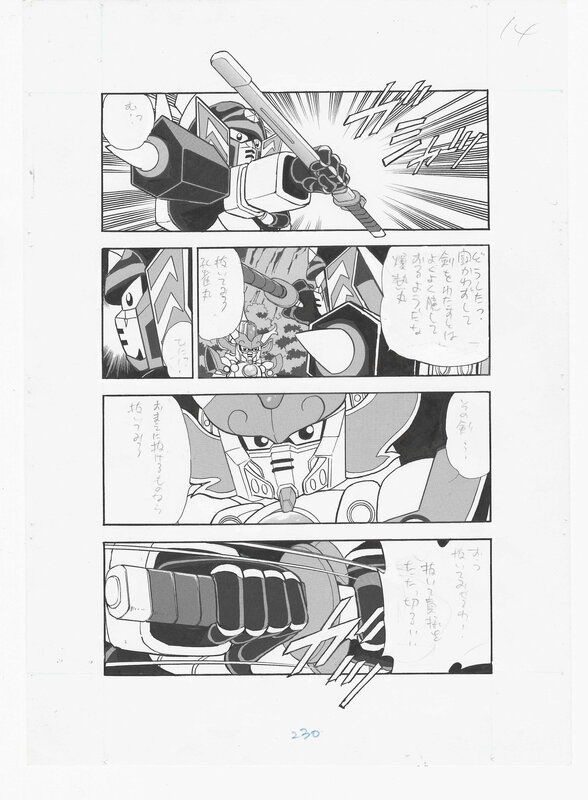
Super Deformed Gundam | Comic BonBon | pg230
Encre de Chine
25.5 x 35.5 cm (10.04 x 13.98 in.)
Prix : 500 €
[$]
Lien copié dans le presse-papier !
Description
Super Deformed Gundam (SDガンダムフォース)
Planche 230
Publication dans Comic BonBon de Kodansha
Planche 230
Publication dans Comic BonBon de Kodansha
Commentaire
Yūji Hosoi (細井 雄二 - 1950) est un mangaka japonais reconnu pour ses nombreuses adaptations de tokusatsu, d’anime et de jeux vidéo manga accessibles et dynamiques. Formé dans des milieux majeurs, du magazine COM de Tezuka au studio d’Ishinomori, il s'affirme très tôt avec une narration claire et rythmée. Ses débuts passent par le cercle doujin Mutant Pro, sous l’influence de Makoto Kanno et Jōji Enami.
Des années 1970 aux années 2000, il devient une figure centrale de la mangaïsation, notamment avec Kamen Rider, qu’il adapte avec fidélité et efficacité pour un jeune public.
Peu connu du grand public hors du Japon, il est cependant très apprécié des collectionneurs pour son rôle dans des séries majeures comme Kamen Rider, Super Sentai et SD Gundam. En 2025, il enseigne encore à temps partiel à l’Université de Kyoto.
Super Deformed Gundam (SD Gundam), qu'Hosoi adapte en 2004, propose une version plus légère et humoristique de l’univers Gundam grâce au style super‑deformed. En mêlant robots, fantasy et références historiques, la série crée un pont entre les différentes timelines du Gundamverse et s’est imposée depuis quarante ans dans l’anime, le manga et le jeu vidéo.
Des années 1970 aux années 2000, il devient une figure centrale de la mangaïsation, notamment avec Kamen Rider, qu’il adapte avec fidélité et efficacité pour un jeune public.
Peu connu du grand public hors du Japon, il est cependant très apprécié des collectionneurs pour son rôle dans des séries majeures comme Kamen Rider, Super Sentai et SD Gundam. En 2025, il enseigne encore à temps partiel à l’Université de Kyoto.
Super Deformed Gundam (SD Gundam), qu'Hosoi adapte en 2004, propose une version plus légère et humoristique de l’univers Gundam grâce au style super‑deformed. En mêlant robots, fantasy et références historiques, la série crée un pont entre les différentes timelines du Gundamverse et s’est imposée depuis quarante ans dans l’anime, le manga et le jeu vidéo.
Yūji Hosoi (born September 27, 1950) is a veteran Japanese mangaka known for his wide-ranging adaptations of Tokusatsu, anime, and video game properties into accessible, engaging manga. Tokusatsu refers to live-action productions that rely heavily on special effects, such as miniature sets, rubber monster suits, and other pre-CGI techniques. Famous examples include Godzilla, Ultraman, Kamen Rider, and the Super Sentai series. Over the course of four decades, Hosoi built a lasting reputation for faithfully translating popular media into manga. His work reflects a unique cross-section of Japanese pop culture, spanning from 1970s TV heroes to the arcade icons of the 1990s.
SD Gundam offers a lighter, more humorous, and youth-oriented take on the original Gundam universe ! Its super-deformed aesthetics, with big heads and smaller bodies, made it appealing to a (at that time) younger audience who wasn’t yet ready for the complex (moral) themes of the standard Gundam series. This accessibility brought a new generation into the franchise. SD Gundam isn’t (just) a parody!
It uses creative reinterpretations of Gundam characters and mobile suits, mixing them with fantasy or historical fiction, blending robots with dragons or bringing them into the period of the Three Kingdoms. This brought stylistic and thematic diversity to the Gundam brand. Though it originally began in the 1980’s as a spinoff, SD Gundam has now four decades of continuity, including anime, manga, and loads of games
The 2004 SD Gundam by Hosoi is based on the anime that aired on Cartoon Network in 2003. It made, at that time, the sub-brand more relevant than the actual Gundam franchise was SD Gundam serves as a bridge between different parts of the franchise. Through the crossover games and series, it links characters and mobile suits from different timelines and universes, giving fans an easy way to explore the broader Gundam multiverse.
Pour laisser un commentaire sur cette œuvre, veuillez vous connecter