In AVTBOB 's collection
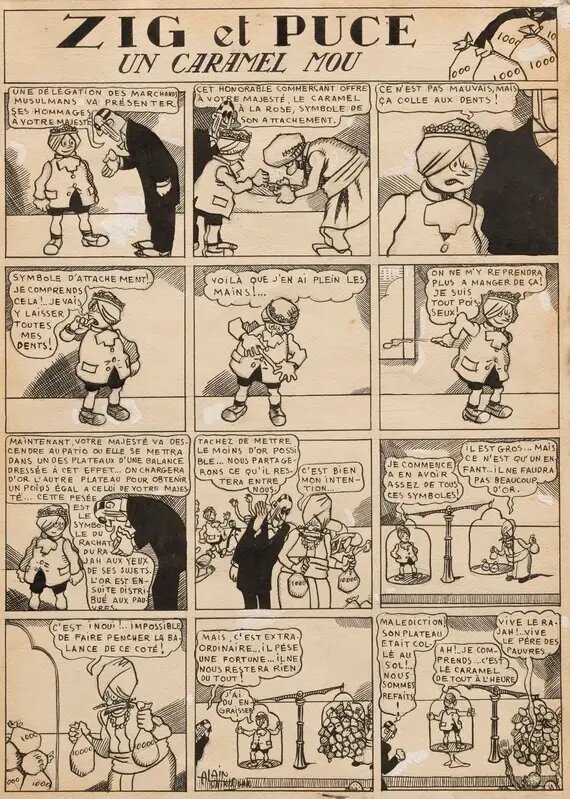
Zig et Puce aux Indes, un caramel mou
Ink
27.6 x 38.5 cm (10.87 x 15.16 in.)
Added on 4/20/26
Link copied to clipboard!
Description
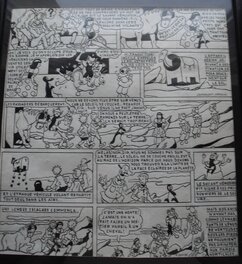
Planche de Zig et Puce par Alain Saint-Ogan parue dans le Dimanche Illustré du 3 mai 1931.
Cette planche, mettant en vedette Puce, correspond à la planche 6 de l'album "Zig et Puce aux Indes" paru en 1995 chez en Glenat. Dans l'EO de l'album en 1932 la planche n'a pas été retenue ...
M. Harang (avec ses lunettes noires) nous rappelle que le jeune dessinateur Hergé, au début des années 30, grand admirateur de Saint-Ogan, s'est beaucoup inspiré des aventures Zig et Puce pour ses personnages secondaires de "méchants" ...
Cette planche, mettant en vedette Puce, correspond à la planche 6 de l'album "Zig et Puce aux Indes" paru en 1995 chez en Glenat. Dans l'EO de l'album en 1932 la planche n'a pas été retenue ...
M. Harang (avec ses lunettes noires) nous rappelle que le jeune dessinateur Hergé, au début des années 30, grand admirateur de Saint-Ogan, s'est beaucoup inspiré des aventures Zig et Puce pour ses personnages secondaires de "méchants" ...
Inscriptions
Alain Saint-Ogan
6 comments
To leave a comment on that piece, please log in
About Alain Saint-Ogan
Alain Saint-Ogan, the son of a newspaper editor, started his career in 1913, when some of his drawings were published for the first time. He served in World War I, and became a cartoonist and newspaperman after his return. In 1925 he created the comics strip 'Zig et Puce', for the French weekly Dimanche Illustré. It was an instant success.
This series featured also a penguin called Alfred, whose character became a popular mascotte, which was even taken by pilot Lindbergh in his famous plane Spirit of St-Louis, when he was the first to cross the Atlantic Ocean. "The Alfred" is now the most coveted prize given at the French Angoulême comics festival. In the 1950s, the series 'Zig et Puce' was taken over by Greg.
Saint-Ogan continued with a number of other comic features, such as 'Mitou et Toti', 'Prosper l'Ours', 'Monsieur Poche' and 'Touitoui'. Apart from creating comics, Saint-Ogan wrote, illustrated and became the editor of children's magazine Benjamin in 1941.
Saint-Ogan was also the main illustrator and editor-in-chief of the magazine Cadet-Revue, that appeared in the 1930s.
Alain Saint-Ogan is widely recognized as the artist who gave a fresh impetus to French comics, introducing an art-deco-look which has inspired countless artists, including the famous Hergé.
Text (c) Lambiek