Dans la collection de SupHermann
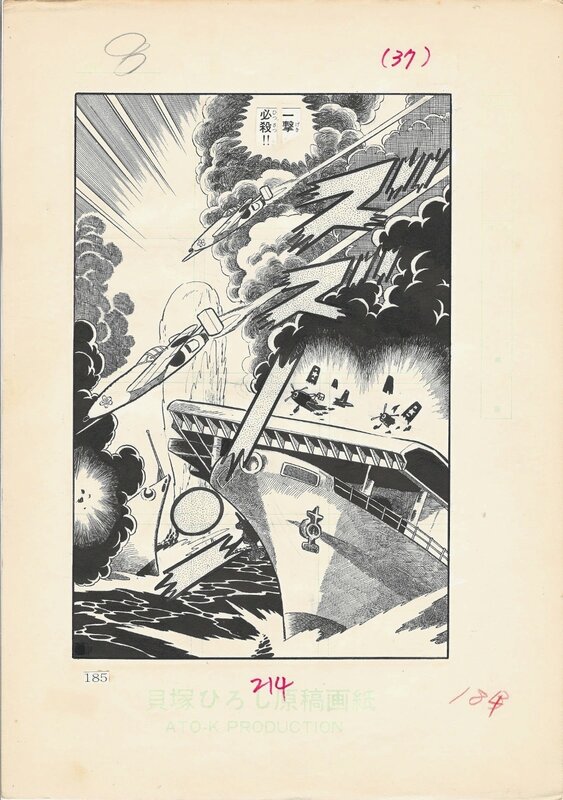
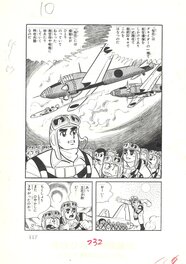
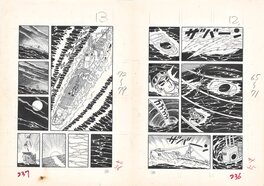
Zero Fighter March #2 p183&184
Encre de Chine
25.5 x 35.8 cm (10.04 x 14.09 in.)
Chaque planche
Ajoutée le 25/10/2025
Lien copié dans le presse-papier !
Description
Zero Fighter March #2
Planche 183 et 184
Planche 183 et 184
Commentaire
Publié dans un Japon en pleine reconstruction économique, ce manga s'inscrit dans un moment particulier où la société japonaise revisitait son passé militaire récent. Destiné à un lectorat adolescent, Zero Fighter March témoigne de la manière dont le manga d'après-guerre pouvait aborder l'histoire nationale à travers le prisme du récit d'aventure populaire. Malgré son approche très shōnen, l'œuvre laisse transparaître la tragédie de ces jeunes vies consumées dans les airs, offrant une réflexion sous-jacente sur l'absurdité de la guerre. Le manga conserve ainsi une ambiguïté entre célébration de l'héroïsme et constat amer de la destruction d'une génération.
Cette série confirme Kaizuka comme figure majeure du manga shōnen des années 1960. Auteur prolifique et influent, il excelle dans les récits d'action au trait énergique. Zero Fighter March représente l'apogée de son travail sur l'aviation militaire, alliant maîtrise technique des scènes de vol et construction dramatique efficace, le tout enrobé d’une approche psychologique rare pour l’époque et le genre.
Ajout en anglais infra
Zero Fighter March" (ゼロ戦行進曲), published between 1967 and 1968 by Hiroshi Kaizuka, is a bold, action-charged war manga that takes readers into the heart of the Pacific skies alongside Shōichi Minami, a young and determined Zero fighter pilot.
With its intense dogfights, dramatic sacrifices, and deep sense of duty, the series captures the energy and emotion of wartime aviation like few other manga of its era.
While Zero-sen Red (1961) is praised for its realism and psychological depth, Zero Fighter March embraces a more heroic and passionate tone, turning the cockpit into a stage for courage, honor, and high-stakes drama.
Kaizuka weaves a tale that’s not just about battle, but about the unbreakable spirit of the young men who flew into history. 'Zero Fighter March' left a strong mark on 1960s readers, especially boys captivated by tales of bravery in the sky.
Today, it stands as a fascinating example of how postwar manga could reimagine Japan’s wartime past through action, emotion, and national memory, blending thrilling spectacle with a nostalgic, almost mythic sense of heroism.
Cette série confirme Kaizuka comme figure majeure du manga shōnen des années 1960. Auteur prolifique et influent, il excelle dans les récits d'action au trait énergique. Zero Fighter March représente l'apogée de son travail sur l'aviation militaire, alliant maîtrise technique des scènes de vol et construction dramatique efficace, le tout enrobé d’une approche psychologique rare pour l’époque et le genre.
Ajout en anglais infra
Zero Fighter March" (ゼロ戦行進曲), published between 1967 and 1968 by Hiroshi Kaizuka, is a bold, action-charged war manga that takes readers into the heart of the Pacific skies alongside Shōichi Minami, a young and determined Zero fighter pilot.
With its intense dogfights, dramatic sacrifices, and deep sense of duty, the series captures the energy and emotion of wartime aviation like few other manga of its era.
While Zero-sen Red (1961) is praised for its realism and psychological depth, Zero Fighter March embraces a more heroic and passionate tone, turning the cockpit into a stage for courage, honor, and high-stakes drama.
Kaizuka weaves a tale that’s not just about battle, but about the unbreakable spirit of the young men who flew into history. 'Zero Fighter March' left a strong mark on 1960s readers, especially boys captivated by tales of bravery in the sky.
Today, it stands as a fascinating example of how postwar manga could reimagine Japan’s wartime past through action, emotion, and national memory, blending thrilling spectacle with a nostalgic, almost mythic sense of heroism.
Thématiques
5 commentaires
Pour laisser un commentaire sur cette œuvre, veuillez vous connecter