In driesd 's collection
Description
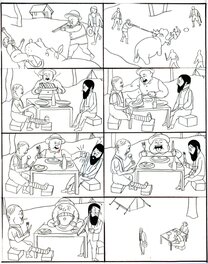
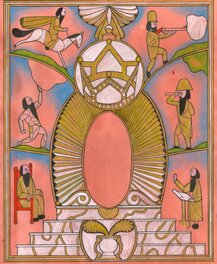
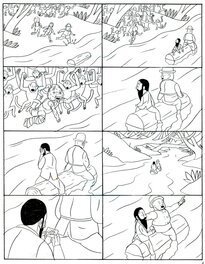
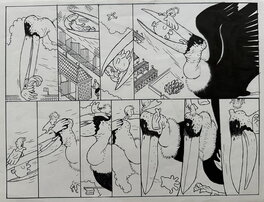
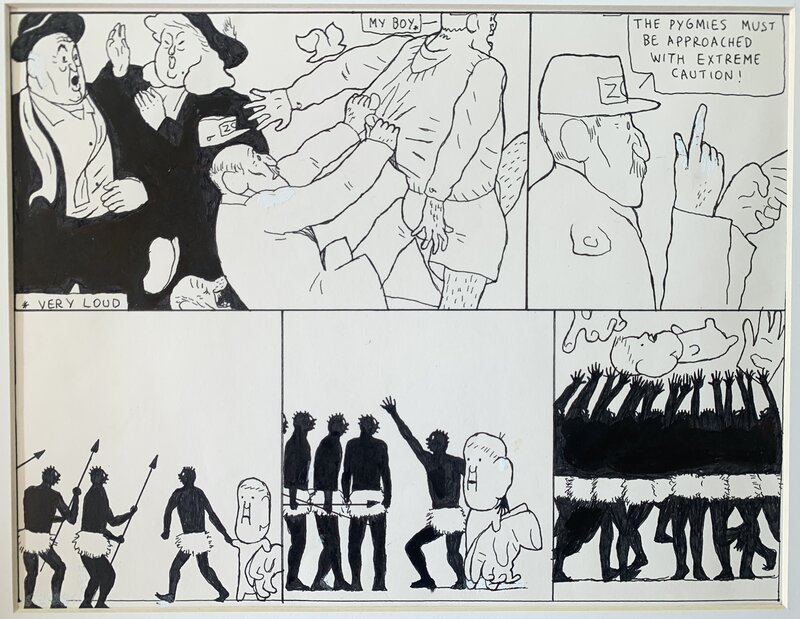
Page from "At the Antwerp Zoo" published in "My Boy".
Comment
Interview with Olivier Schrauwen (English and French):
https://www.du9.org/en/entretien/olivier-schrauwen-2/
BENOÎT CRUCIFIX : Now, although there is no direct reference to the Congo, Belgium and ‘the Colony’ are explicitly mentioned in Arsène, and the story has some ironic affinities with the colonial adventure genre that is so frequent in traditional comics. In fact this colonial theme seems like a recurrent but oblique theme in your work : the pygmies in the Antwerp zoo in My Boy, “Congo Chromo,” several references to Leopold II, etc. How did the colonial imaginary influence your work ? How do you see your relationship to that history ?
OLIVIER SCHRAUWEN : The colonial imagery is ubiquitous in Belgium, it’s in old comics, you’ll see statues of Leopold II in the street, the pompous buildings that were financed with colonial money. Also my grandmother gave me these old books with idealized depictions of colonial life and of course there was (the real) Arsène’s colonial paraphernalia ( his hat, his stick) laying around.
Early on I was trying to set my comics apart by situating them in the past, undoubtedly influenced by Chris Ware, and this period in Belgian history seemed interesting. In my late teens and early twenties all my comics dealt with ‘paternalism’ (10 years of very strict catholic schooling must’ve had something to do with that) and the colonial situation was the perfect arena to talk about that.
Over the years I kept revisiting this semi fictional Congo and it has become more abstract, it was never historically correct and it has become only less so. My thematic focus has also shifted as I got older.
Something strange and unplanned is that I’ve been drawing the Conglese people increasingly smaller in consecutive strips. In the earliest stories they have a normal size, in My Boy there about 30 cm tall, in “Congo Chromo” you can only see them from afar and in Arsène they’ve all but disappeared.
https://www.du9.org/en/entretien/olivier-schrauwen-2/
BENOÎT CRUCIFIX : Now, although there is no direct reference to the Congo, Belgium and ‘the Colony’ are explicitly mentioned in Arsène, and the story has some ironic affinities with the colonial adventure genre that is so frequent in traditional comics. In fact this colonial theme seems like a recurrent but oblique theme in your work : the pygmies in the Antwerp zoo in My Boy, “Congo Chromo,” several references to Leopold II, etc. How did the colonial imaginary influence your work ? How do you see your relationship to that history ?
OLIVIER SCHRAUWEN : The colonial imagery is ubiquitous in Belgium, it’s in old comics, you’ll see statues of Leopold II in the street, the pompous buildings that were financed with colonial money. Also my grandmother gave me these old books with idealized depictions of colonial life and of course there was (the real) Arsène’s colonial paraphernalia ( his hat, his stick) laying around.
Early on I was trying to set my comics apart by situating them in the past, undoubtedly influenced by Chris Ware, and this period in Belgian history seemed interesting. In my late teens and early twenties all my comics dealt with ‘paternalism’ (10 years of very strict catholic schooling must’ve had something to do with that) and the colonial situation was the perfect arena to talk about that.
Over the years I kept revisiting this semi fictional Congo and it has become more abstract, it was never historically correct and it has become only less so. My thematic focus has also shifted as I got older.
Something strange and unplanned is that I’ve been drawing the Conglese people increasingly smaller in consecutive strips. In the earliest stories they have a normal size, in My Boy there about 30 cm tall, in “Congo Chromo” you can only see them from afar and in Arsène they’ve all but disappeared.
Publications
- My boy
- Bries
- 2006
- Interior page
-
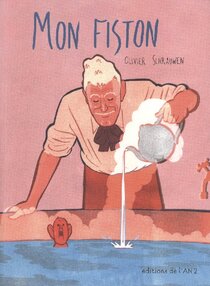
- Mon Fiston
- Éditions De L'an 2
- 08/2006
- Interior page
-

- Mi pequeno / My Boy
- Norma Editorial
- 2009-05-30
- Interior page
-
1 comment
To leave a comment on that piece, please log in