Dans la collection de goldgrube
Norakuro (のらくろ) | Shōnen | Iconic Prewar Manga
Techniques mixtes
39.5 x 27.5 cm (15.55 x 10.83 in.)
Ajoutée le 23/03/2026
Lien copié dans le presse-papier !
Description
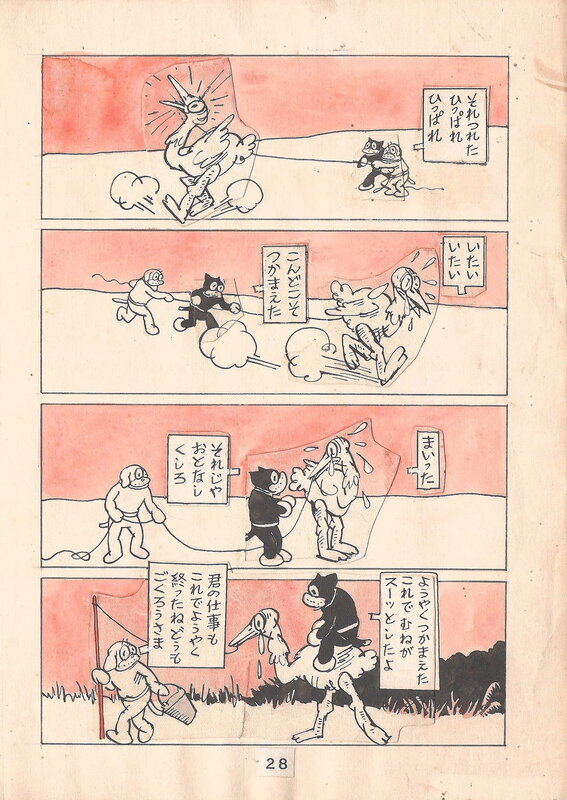
Norakuro | のらくろ | published in Shōnen Kurabu, 1937
Norakuro is a prewar Japanese manga series created by Suihō Tagawa, serialized in Shōnen Club from 1931 to 1940. It's one of the most popular manga in Japan and remains one of the foundational works of modern Japanese manga.
Norakuro is considered a symbol and even a mascot of both Japan and manga, often associated with ideas of resilience in Japanese popular culture.
The story follows Norakuro, a black-and-white stray dog who joins the “Fierce Dog Brigade,” a military unit composed of dogs engaged in battles against enemies such as the Monkey Army and the Chimpanzee Army. Norakuro is a partly inspired by Felix the Cat. His name is derived from norainu, meaning “stray dog” and Kurokichi (黒吉), his given name, meaning “black luck.”
Early Norakuro was primarily comedic, depicting military life in a humorous and often satirical way but the tone of the series evolved over the course of its publication.
From the mid-1930s onward, particularly during the Second Sino-Japanese War, the content became more closely aligned with the increasingly militarized atmosphere of the time.
Suihō Tagawa donated his original caricatures and cartoons to the Machida City Museum; as a result, relatively little artwork remains in private hands, making Norakuro pages highly sought after both in Japan and internationally
Norakuro is a prewar Japanese manga series created by Suihō Tagawa, serialized in Shōnen Club from 1931 to 1940. It's one of the most popular manga in Japan and remains one of the foundational works of modern Japanese manga.
Norakuro is considered a symbol and even a mascot of both Japan and manga, often associated with ideas of resilience in Japanese popular culture.
The story follows Norakuro, a black-and-white stray dog who joins the “Fierce Dog Brigade,” a military unit composed of dogs engaged in battles against enemies such as the Monkey Army and the Chimpanzee Army. Norakuro is a partly inspired by Felix the Cat. His name is derived from norainu, meaning “stray dog” and Kurokichi (黒吉), his given name, meaning “black luck.”
Early Norakuro was primarily comedic, depicting military life in a humorous and often satirical way but the tone of the series evolved over the course of its publication.
From the mid-1930s onward, particularly during the Second Sino-Japanese War, the content became more closely aligned with the increasingly militarized atmosphere of the time.
Suihō Tagawa donated his original caricatures and cartoons to the Machida City Museum; as a result, relatively little artwork remains in private hands, making Norakuro pages highly sought after both in Japan and internationally
Commentaire
Suihō Tagawa (1899–1989) was a Tokyo-born artist who, before becoming a professional mangaka, served in the Imperial Japanese Army, an experience that formed the military setting and themes of his most famous work. He began his career as an illustrator and gained recognition with the success of Norakuro, which established him as one of the leading figures in children’s manga during the prewar period.
During the war years, his work increasingly reflected the national context, and like many artists of the time, he contributed to publications aligned with wartime culture. After Japan’s defeat in 1945, Tagawa temporarily ceased drawing Norakuro, later reintroducing the character in a demilitarized setting.
From the 1960s through the 1980s, he resumed regular production of Norakuro, adapting the character to new audiences and contexts. Over the course of his career, Tagawa played a significant role in shaping early manga as a popular medium for children. Today, he is regarded as one of the pioneers of Japanese manga, particularly for his contribution to the development of long-running serialized storytelling in illustrated form.
• Ostrich: "Heh heh heh, I escaped! I escaped!" (ひひひ、それ逃げた、それ逃げた)
• Ostrich: "Ouch, ouch! It hurts, it hurts!" (いたい、いたい! いたい、いたい)
• Soldier (left): "Alright, I've got you now!" (こんどこそ つかまえたぞ)
• Norakuro (middle): "Wait a minute... if that's the case, then this must be..." (それじゃ おとなしく しろ)
• Ostrich: "I give up..." (まいった)
• Norakuro: "I finally caught you! Now my work here is done." (ようやく つかまえた。これで わが 君の仕事も これで ようやく 終ったねです)
• Soldier (left): "Well done, Norakuro!" (ごくろうさま)
During the war years, his work increasingly reflected the national context, and like many artists of the time, he contributed to publications aligned with wartime culture. After Japan’s defeat in 1945, Tagawa temporarily ceased drawing Norakuro, later reintroducing the character in a demilitarized setting.
From the 1960s through the 1980s, he resumed regular production of Norakuro, adapting the character to new audiences and contexts. Over the course of his career, Tagawa played a significant role in shaping early manga as a popular medium for children. Today, he is regarded as one of the pioneers of Japanese manga, particularly for his contribution to the development of long-running serialized storytelling in illustrated form.
• Ostrich: "Heh heh heh, I escaped! I escaped!" (ひひひ、それ逃げた、それ逃げた)
• Ostrich: "Ouch, ouch! It hurts, it hurts!" (いたい、いたい! いたい、いたい)
• Soldier (left): "Alright, I've got you now!" (こんどこそ つかまえたぞ)
• Norakuro (middle): "Wait a minute... if that's the case, then this must be..." (それじゃ おとなしく しろ)
• Ostrich: "I give up..." (まいった)
• Norakuro: "I finally caught you! Now my work here is done." (ようやく つかまえた。これで わが 君の仕事も これで ようやく 終ったねです)
• Soldier (left): "Well done, Norakuro!" (ごくろうさま)
Pour laisser un commentaire sur cette œuvre, veuillez vous connecter