Dans la collection de goldgrube
Description
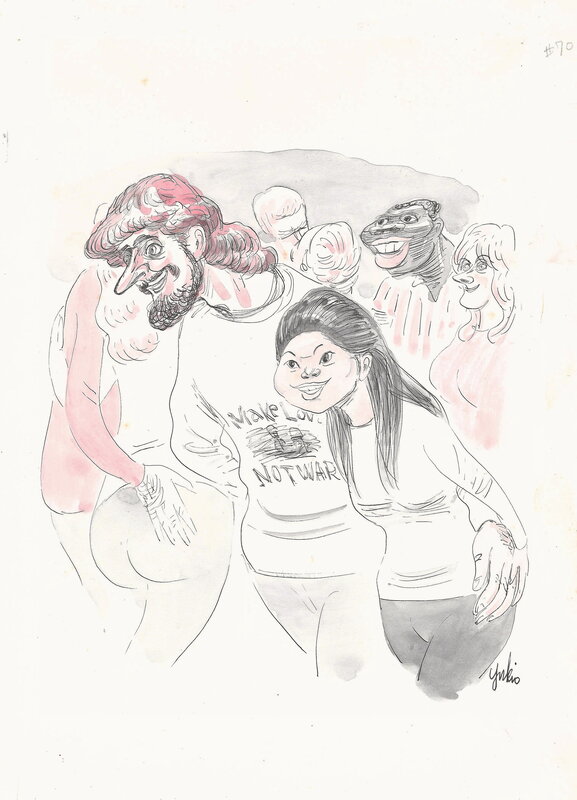
Yukio Sugiura (1911–2004) was a Japanese manga artist best known for his nonsense manga, which combined humor with a distinctive sex appeal rooted in the fashions, gestures, and everyday habits of women seen on the streets.
Commentaire
Introverted as a child, Sugiura preferred drawing alone and was deeply influenced by the work of George McManus, serialized in Asahi Graph, which inspired his ambition to become a mangaka. Determined to pursue art, he studied painting at several well-known institutions, including the Hongo Western Painting Institute, Kawabata Art School, and Doshusha. In 1929, he took the entrance examination for the Tokyo School of Fine Arts, but was reprimanded for smoking during the practical exam. The confrontation escalated into a heated argument, and Sugiura was expelled from the examination hall.
After failing the entrance exam, Sugiura was accepted into Ippei Juku, where he met Hidezō Kondo, who would later become a frequent collaborator. Around this time, he was strongly influenced by cartoons published in foreign magazines such as Esquire, The New Yorker, and Le Rire. In 1931, he submitted work to Asahi Graph, where his cartoons were published and earned him his first cash prize of 7 JPY (approximately €25 in 2025). In 1932, together with Hidezō Kondo and Ryūichi Yokoyama, he formed the New Manga Group, a collective that would ignite a nationwide boom in nonsense manga.
Within the group, Sugiura was particularly struck by the exceptional talent and technique of Ryūichi Yokoyama. Feeling that he could not compete directly in the same domain, Sugiura resolved to pursue what Yokoyama could not: he noted that Yokoyama’s female characters lacked sensuality and decided to focus on fashion and customs manga with women as protagonists.
With the ambition of becoming “Japan’s greatest manga artist at drawing women,” he turned increasingly toward comics centered on beautiful women, carving out his own distinctive artistic path.
In 1933, Sugiura severed ties with Asahi Graph after protesting unauthorized changes made by an editor. Shortly thereafter, he joined the manga department of the Yomiuri Shimbun, where he again worked alongside Hidezō Kondo. His series Hanako-san on the Home Front became a major hit. During the wartime period, as censorship intensified, Sugiura, who described himself as a “spiritual anarchist”, published work in the magazine Manga, led by Kondo, where he quietly resisted militarism by embedding war-weary undertones and motifs into his cartoons.
After the war, Sugiura resumed full-scale activity as a manga artist. Together with Yokoyama, Kondo, and Shimizu Kon, he reorganized the New Manga Group into the Manga Group, playing a key role in nurturing the next generation of manga artists. Responding to the liberalized postwar social climate, he began incorporating erotic and grotesque elements into his work alongside the cheerful tone that had characterized his prewar family manga. His serials featuring lively female protagonists who “exuded healthy eroticism,” such as Atomic no Obon and Tokyo Chaki Chaki Musume, gained widespread popularity and were later adapted into live-action films.
Sugiura was involved in the founding of the Japan Cartoonists Association in 1964 and became its chairman in 1976. In 1983, at the age of 72, he began Omokage no Hito (The Woman with a Face) in Weekly Manga Sunday. The series ran for over 20 years and concluded in May 2003 after 1,004 publications!
Throughout his career, Sugiura consistently focused on women as his central theme, stating that his goal was to create manga that praised, worshipped, and celebrated women. He treated nudity as materialistic and humorous, deliberately avoiding depictions of sexual violence. At the same time, his view of women could be emotionally detached; he once told Osamu Go, “I have fallen in love with women many times, but I have never been in love.”
Sugiura excelled at single-panel compositions that condensed complex social observations into a single image. Tadao Satō praised his work for its rare balance of humor, eroticism, and precise observation of manners and customs, noting that it vividly conveyed the realities of everyday life. His depictions of beautiful women influenced artists such as Isao Kojima, though Sugiura modestly remarked that he did not draw with Kojima’s elegance.
He maintained a lifelong love of nightlife and alcohol, believing that one could not create good manga without living a refined lifestyle. Frequenting high-end restaurants and bars in the Ginza district, he regarded such places not only as venues for pleasure but also as a “school of life” that provided inspiration for his work. Following the advice of his mentor Ippei Okamoto, who claimed that nothing good comes from a manga artist saving money, Sugiura spent most of his income on entertainment, leaving little in savings. He continued writing and drawing manga almost until his death, remaining active throughout his long life.
After failing the entrance exam, Sugiura was accepted into Ippei Juku, where he met Hidezō Kondo, who would later become a frequent collaborator. Around this time, he was strongly influenced by cartoons published in foreign magazines such as Esquire, The New Yorker, and Le Rire. In 1931, he submitted work to Asahi Graph, where his cartoons were published and earned him his first cash prize of 7 JPY (approximately €25 in 2025). In 1932, together with Hidezō Kondo and Ryūichi Yokoyama, he formed the New Manga Group, a collective that would ignite a nationwide boom in nonsense manga.
Within the group, Sugiura was particularly struck by the exceptional talent and technique of Ryūichi Yokoyama. Feeling that he could not compete directly in the same domain, Sugiura resolved to pursue what Yokoyama could not: he noted that Yokoyama’s female characters lacked sensuality and decided to focus on fashion and customs manga with women as protagonists.
With the ambition of becoming “Japan’s greatest manga artist at drawing women,” he turned increasingly toward comics centered on beautiful women, carving out his own distinctive artistic path.
In 1933, Sugiura severed ties with Asahi Graph after protesting unauthorized changes made by an editor. Shortly thereafter, he joined the manga department of the Yomiuri Shimbun, where he again worked alongside Hidezō Kondo. His series Hanako-san on the Home Front became a major hit. During the wartime period, as censorship intensified, Sugiura, who described himself as a “spiritual anarchist”, published work in the magazine Manga, led by Kondo, where he quietly resisted militarism by embedding war-weary undertones and motifs into his cartoons.
After the war, Sugiura resumed full-scale activity as a manga artist. Together with Yokoyama, Kondo, and Shimizu Kon, he reorganized the New Manga Group into the Manga Group, playing a key role in nurturing the next generation of manga artists. Responding to the liberalized postwar social climate, he began incorporating erotic and grotesque elements into his work alongside the cheerful tone that had characterized his prewar family manga. His serials featuring lively female protagonists who “exuded healthy eroticism,” such as Atomic no Obon and Tokyo Chaki Chaki Musume, gained widespread popularity and were later adapted into live-action films.
Sugiura was involved in the founding of the Japan Cartoonists Association in 1964 and became its chairman in 1976. In 1983, at the age of 72, he began Omokage no Hito (The Woman with a Face) in Weekly Manga Sunday. The series ran for over 20 years and concluded in May 2003 after 1,004 publications!
Throughout his career, Sugiura consistently focused on women as his central theme, stating that his goal was to create manga that praised, worshipped, and celebrated women. He treated nudity as materialistic and humorous, deliberately avoiding depictions of sexual violence. At the same time, his view of women could be emotionally detached; he once told Osamu Go, “I have fallen in love with women many times, but I have never been in love.”
Sugiura excelled at single-panel compositions that condensed complex social observations into a single image. Tadao Satō praised his work for its rare balance of humor, eroticism, and precise observation of manners and customs, noting that it vividly conveyed the realities of everyday life. His depictions of beautiful women influenced artists such as Isao Kojima, though Sugiura modestly remarked that he did not draw with Kojima’s elegance.
He maintained a lifelong love of nightlife and alcohol, believing that one could not create good manga without living a refined lifestyle. Frequenting high-end restaurants and bars in the Ginza district, he regarded such places not only as venues for pleasure but also as a “school of life” that provided inspiration for his work. Following the advice of his mentor Ippei Okamoto, who claimed that nothing good comes from a manga artist saving money, Sugiura spent most of his income on entertainment, leaving little in savings. He continued writing and drawing manga almost until his death, remaining active throughout his long life.
Pour laisser un commentaire sur cette œuvre, veuillez vous connecter