In goldgrube 's collection
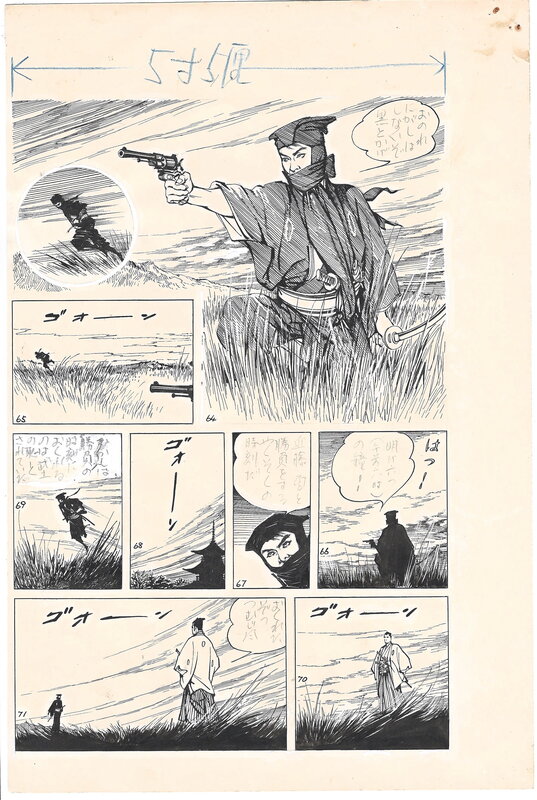
Kurama Sword Chronicle | Houbunsha Bunko | Sōjōbō
Ink
26 x 36 cm (10.24 x 14.17 in.)
Added on 3/28/26
Link copied to clipboard!
Description
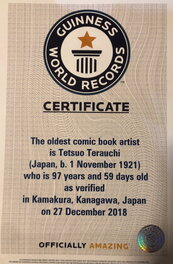
Ueki Kinya (植木金矢, 1921–2019), born Terauchi Tetsuo, belongs to a generation of artists whose lives were violently interrupted by war and who then helped reinvent Japanese visual culture from the ground up.
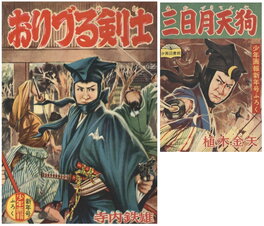
His breakthrough came in the early 1950s with historical action works centered on the Kurama hero archetype, including titles such as Kurama Sword Chronicle and Kurama Swordsman.
These stories drew on the popular figure of Kurama Tengu, also known as Sōjōbō, the legendary king of the tengu who lived on Mount Kurama near Kyoto.
Ueki transformed this familiar material into something visually new. His pages were built like movies: dynamic compositions, sharply staged action, and characters modelled on contemporary jidaigeki (period drama) film stars.
His cinematic intensity places Ueki in a crucial but often overlooked position in manga history. He was not part of the Tezuka lineage, nor was he formally associated with the later gekiga movement, yet his work clearly anticipates it.
His breakthrough came in the early 1950s with historical action works centered on the Kurama hero archetype, including titles such as Kurama Sword Chronicle and Kurama Swordsman.
These stories drew on the popular figure of Kurama Tengu, also known as Sōjōbō, the legendary king of the tengu who lived on Mount Kurama near Kyoto.
Ueki transformed this familiar material into something visually new. His pages were built like movies: dynamic compositions, sharply staged action, and characters modelled on contemporary jidaigeki (period drama) film stars.
His cinematic intensity places Ueki in a crucial but often overlooked position in manga history. He was not part of the Tezuka lineage, nor was he formally associated with the later gekiga movement, yet his work clearly anticipates it.
4 comments
To leave a comment on that piece, please log in