In driesd 's collection
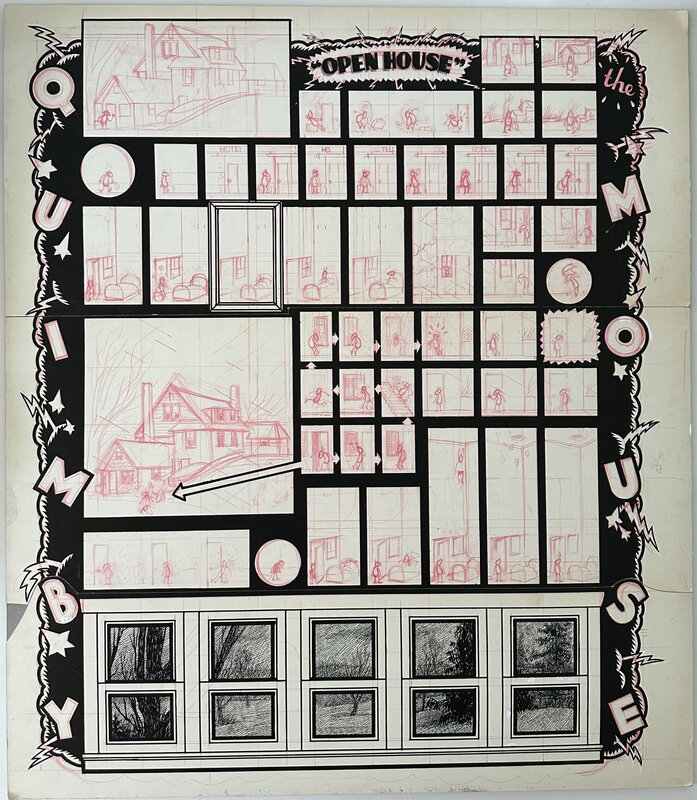
Chris Ware - Quimby the Mouse
Mixed Media
Ink, colored pencil and white gouache on board
61 x 70.3 cm (24.02 x 27.68 in.)
Added on 6/27/26
Link copied to clipboard!
Comment
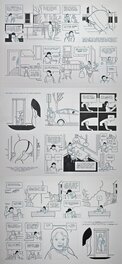
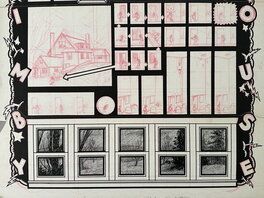
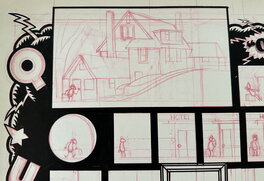
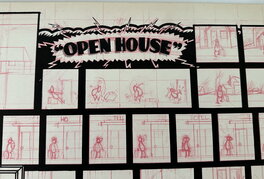
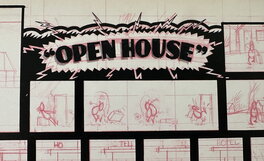
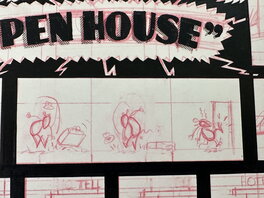
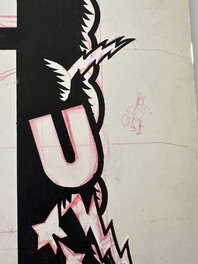
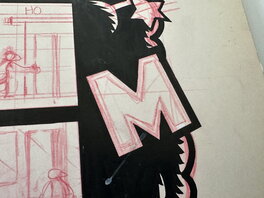
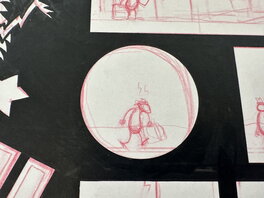
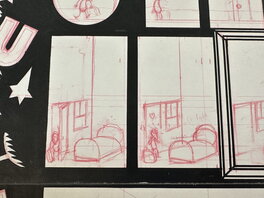
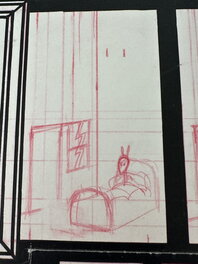
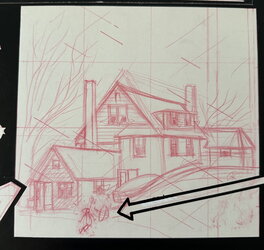
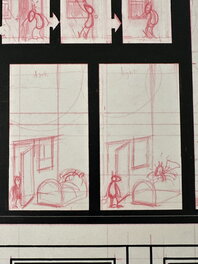
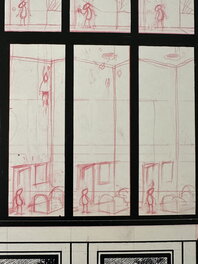
Chris Ware Quimby Mouse Comic Strip Partially Inked Original Art dated 10-25-1990 (The Daily Texan, 1990). In the one-page story, "Open House", Quimby cannot get into the house, so he checks into a Hotel. Later he finds the house unlocked and the windows open. Getting locked out again, he returns to his Hotel room to find "Super Quimby" asleep in his bed! It was reprinted on Page 17 in Acme Novelty Library #2 by Fantagraphics in 1994. Created in three sections of Bristol board affixed to a large illustration board. The bottom section is fully finished, but all of the Quimby panels above that are roughed in with pure red pencil. Created in ink over red pencil with a combined image area of 22.5" x 26".
Chris Ware in Monograph:
My strips for the Daily Texan shifted entirely over to “Quimby the Mouse” in 1990, which morphed into a two-headed character for the last few months of my grandmother’s life as her sharp, funny, and empathetic personality broke into pieces and faded away. Following her death in December, I drew a series of stories set in my memories of her house using a complicated triple-burn experiment which combined a limited contrast blurred line art image with a sharp cartooned mouse seeming to float on top of it all. Pre-Photoshop, it required three sets of negatives and some hand-masking on each, which the technical employees of the Daily Texan darkroom (headed by Joel Briones) both tolerated and tirelessly helped me with, while, I’m sure, thoroughly being annoyed by. I would buy them beer as thank-yous (and as an apology) in the Winsor McCay tradition, however, to try to account. Later, I abandoned the more complicated blurring effect for a group of stories pairing the mouse with a cat head named “Sparky” in strips which were about the unconscious anger and co-dependency of relationships. I was trying to make strips that not only had an emotional resonance but also, as compositions, had some aesthetic authority and feeling on the page. Though I rarely heard anything about my strips outside of the occasional letter to the editor or comments from friends, one night I was at a party and overheard someone refer to those “weird mouse comics” as “lovely but utterly incomprehensible.” (Monograph)
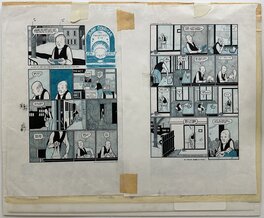
In Monograph you can see a full page reproduction of the original art of one of the other Quimby the Mouse pages for which he used the same triple-burn experiment.

Publication in "The Daily Texan" on the 25th of October 1990.

Notice the differences with the publication in The Acme Novelty Library 2... (eg direction big arrow changed).


"Photos I took of my grandmother's house as reference and which I pinned to the wall of my studio.
thus the spatters of paint and ink." (Monograph)

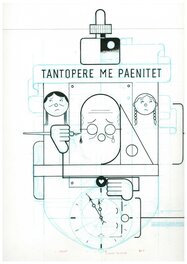
Detail of the cover of The Acme Novelty Library 21 (2026). This shows the importance of architecture and buildings in Chris Ware's body of work and particularly the house of his grandmother... btw the numbers refer to the issues of Acme Novelty Library where those buildings played an important role in.
Chris Ware in Monograph:
My strips for the Daily Texan shifted entirely over to “Quimby the Mouse” in 1990, which morphed into a two-headed character for the last few months of my grandmother’s life as her sharp, funny, and empathetic personality broke into pieces and faded away. Following her death in December, I drew a series of stories set in my memories of her house using a complicated triple-burn experiment which combined a limited contrast blurred line art image with a sharp cartooned mouse seeming to float on top of it all. Pre-Photoshop, it required three sets of negatives and some hand-masking on each, which the technical employees of the Daily Texan darkroom (headed by Joel Briones) both tolerated and tirelessly helped me with, while, I’m sure, thoroughly being annoyed by. I would buy them beer as thank-yous (and as an apology) in the Winsor McCay tradition, however, to try to account. Later, I abandoned the more complicated blurring effect for a group of stories pairing the mouse with a cat head named “Sparky” in strips which were about the unconscious anger and co-dependency of relationships. I was trying to make strips that not only had an emotional resonance but also, as compositions, had some aesthetic authority and feeling on the page. Though I rarely heard anything about my strips outside of the occasional letter to the editor or comments from friends, one night I was at a party and overheard someone refer to those “weird mouse comics” as “lovely but utterly incomprehensible.” (Monograph)
In Monograph you can see a full page reproduction of the original art of one of the other Quimby the Mouse pages for which he used the same triple-burn experiment.
Publication in "The Daily Texan" on the 25th of October 1990.
Notice the differences with the publication in The Acme Novelty Library 2... (eg direction big arrow changed).
"Photos I took of my grandmother's house as reference and which I pinned to the wall of my studio.
thus the spatters of paint and ink." (Monograph)
Detail of the cover of The Acme Novelty Library 21 (2026). This shows the importance of architecture and buildings in Chris Ware's body of work and particularly the house of his grandmother... btw the numbers refer to the issues of Acme Novelty Library where those buildings played an important role in.
Publications
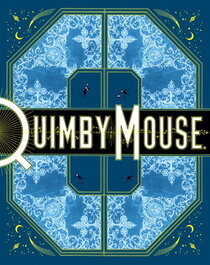
- Quimby the Mouse
- Fantagraphics Books
- 08/2003
- Interior page
-
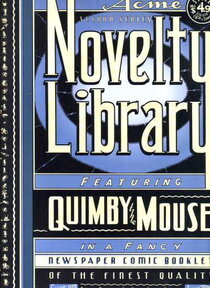
- Quimby the mouse
- Fantagraphics Books
- 06/1994
- Interior page
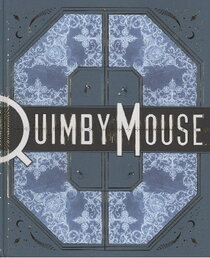
- Quimby the Mouse
- L'association
- 10/2005
- Interior page
-
6 comments
To leave a comment on that piece, please log in
About Chris Ware
Franklin Christenson Ware, known as Chris Ware, is an American comic book writer. Since 1993 he has published the Acme Novelty Library, a series with an irregular format and periodicity. Jimmy Corrigan, his main work (1995-2000), has won him numerous awards in the English-speaking world (several Ignatz, Harved and Eisner awards, as well as an American Book Award and the Guardian First Book Award) as well as in the French-speaking world ("Prix du meilleur album" at the Angoulême Festival and the Prix de la critique).