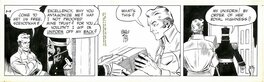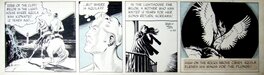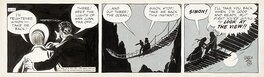
In patler 's collection
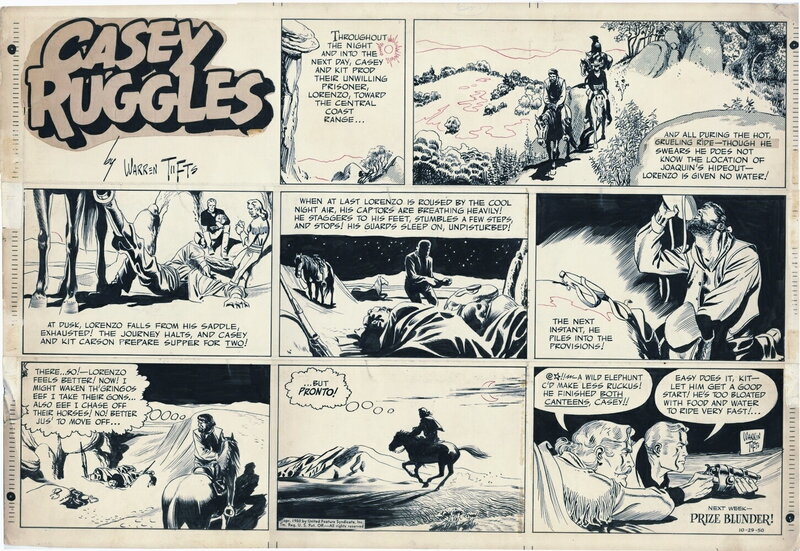
Casey Ruggles
Ink
61 x 43 cm (24.02 x 16.93 in.)
Added on 2/4/26
Link copied to clipboard!
Description
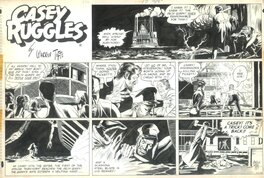
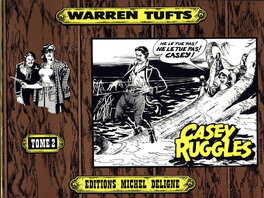
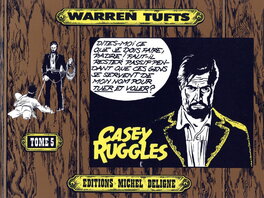
Sunday du 29 octobre 1950 . Publié pour l'édition française chez Michel Deligne de 1979 à 1980 en 8 volumes.
Inscriptions
Signé dans le titre
Comment
Un Sunday de Casey Ruggles par Warren Tufts dont le dessin très réaliste et tres précis n'est pas sans rappeler ceux d'Harold Foster ou d'Alex Raymond dans cette même période...
Casey Ruggles est une bande dessinée western américaine créée, écrite et illustrée par Warren Tufts, et diffusée par United Feature Syndicate du 22 mai 1949 au 30 octobre 1955. Warren Tufts arrêtera de la dessiner en 1954 suite à des différents avec United Features .
Elle sera reprise jusqu'en octobre 1955 par Al Carreno.
La série relate les aventures de Casey Ruggles, ancien sergent de l'armée américaine, durant la ruée vers l'or en Californie. Elle mêle des personnages historiques comme Kit Carson et Jean Lafitte à des péripéties fictives mêlant romance, duels et justice expéditive.
Casey Ruggles est une bande dessinée western américaine créée, écrite et illustrée par Warren Tufts, et diffusée par United Feature Syndicate du 22 mai 1949 au 30 octobre 1955. Warren Tufts arrêtera de la dessiner en 1954 suite à des différents avec United Features .
Elle sera reprise jusqu'en octobre 1955 par Al Carreno.
La série relate les aventures de Casey Ruggles, ancien sergent de l'armée américaine, durant la ruée vers l'or en Californie. Elle mêle des personnages historiques comme Kit Carson et Jean Lafitte à des péripéties fictives mêlant romance, duels et justice expéditive.
5 comments
To leave a comment on that piece, please log in
About Warren Tufts
In 1949, Warren Tufts created the comic strip Casey Ruggles, set against the backdrop of the Old West. Distributed by United Feature, launching May 22, 1949, it initially appeared only in the Sunday comics, but when the story became popular, a daily strip was added. Because Tufts was a perfectionist who often worked 80-hour weeks, he had trouble meeting deadlines, even though he had help from numerous assistants and ghosts: Nick Cardy, Ruben Moreira, Al Plastino and Alex Toth.
As Casey Ruggles' popularity grew, Tufts received an offer from a major television studio to produce a Casey Ruggles TV show. However, United Feature nixed the offer on the grounds that a TV show would make the strip less popular. In anger, Tufts left United Feature in 1954, and Casey Ruggles ended shortly afterward, as the replacement artist, Al Carreño, apparently could not maintain reader interest. Tufts' contract with the syndicate required that they be given first refusal on his next strip, so he created The Lone Spaceman, a science-fiction Lone Ranger parody he was sure United Feature would refuse. After the syndicate did, Tufts reconsidered the strip's value and self-syndicated it.He then created, wrote, drew and self-syndicated one of the last and full-page comic strips, the Old West cavalry adventure Lance, which comics critic Bill Blackbeard called "the best of the page-high adventure strips"