Dans la collection de goldgrube
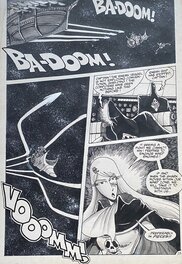
Captain Harlock #13 | Albator, le corsaire de l'espace | Eternity / Malibu
Encre de Chine
25.5 x 38 cm (10.04 x 14.96 in.)
Ajoutée le 26/08/2026
Lien copié dans le presse-papier !
Description
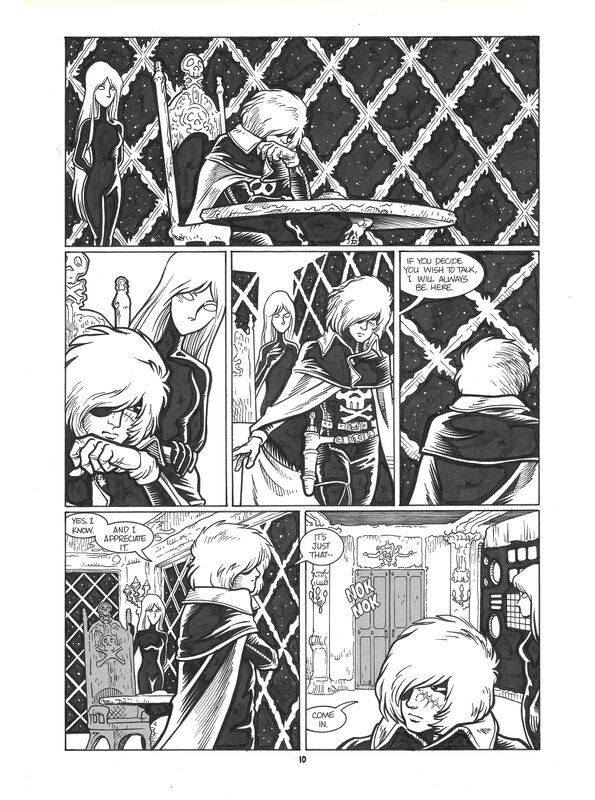
Original Amerimanga page of Captain Harlock #13, published by Eternity / Malibu (April 1991)
Page n°10 featuring Harlock & Miime / Mimay aboard the Arcadia.
Page n°10 featuring Harlock & Miime / Mimay aboard the Arcadia.
Commentaire
Captain Harlock by Leiji Matsumoto is one of the great icons of Japanese science-fiction manga. Albator reached his mature form in the 1977–79 Captain Harlock manga and gained worldwide popularity with the 1978 animated adaptation.
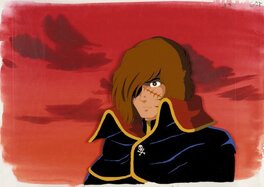
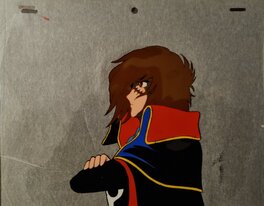
Captain Harlock became the image of the romantic space pirate: solitary, melancholic, rebellious and instantly recognisable through his scarred face, eyepatch, cape and the skull emblem of the Arcadia.
In France and Belgium, his importance is difficult to overstate. Le Corsaire de l’espace, a.k.a. Albator 78, was broadcast in 1980 on Antenne 2 in Récré A2, and became one of the defining anime heroes of the first great wave of Japanese animation on French television, alongside titles such as Goldorak, Candy, Cobra, Ulysse 31, Capitaine Flam, Dragon Ball and Saint Seiya.
Albator’s popularity explains why the character continues to live strongly in France long after the original broadcasts. A great modern-day example is the work of French artist Jérôme Alquié, who created Capitaine Albator - Mémoires de l’Arcadia, a Franco-Belgian reinterpretation of Matsumoto’s universe, published in 2019.
Because Harlock is so closely connected to Matsumoto’s own visual universe, very few artists outside Japan have had the opportunity to draw Albator in original published comic form, especially in the 1980s and 1990s.
The American Captain Harlock comics, published in the early 1990s by Eternity / Malibu, are remarkable exceptions. They were not simple translations or imported editions, but new comics based on Matsumoto’s universe, created before manga and anime had become a mainstream global language.
Tim Eldred occupies a special place within that history. After Ben Dunn launched the American Captain Harlock comics, Eldred became the main artist and drew no fewer than 17 original Harlock comics, 3 issues of The Pirate Queen Emeraldas and even 6 Star Blazers / Space Battleship Yamato comics, all connected to the world of Leiji Matsumoto.
His work belongs to early Amerimanga: Western comics visibly shaped by Japanese manga and anime, at a time when that influence was still rare, experimental and far from fashionable.
Tim did not launch Captain Harlock in the US, but he surely refined it. Looking at his original art, it lies very close to the original manga artwork of Leiji Matsumoto, with a strong influence from the then very popular anime series.
Eldred was one of the few American artists of his generation to build such a remarkable portfolio of published comic work around Japanese anime and manga properties. Beyond Captain Harlock, his career connects to titles such as Armored Trooper Votoms, Star Blazers, M.D. Geist, Project A-ko and Cyber City Oedo 808.
His work stands out at the crossroads between Japanese science-fiction imagery, American comic-book production and the first serious Western attempts to work inside the visual worlds of anime and manga.
For collectors and curators, this illustration is important as a document of cultural passage. It shows Captain Harlock / Albator through published comic art created in the United States. It is an early and rare example of Matsumoto’s universe being reinterpreted inside Western comics before the global manga boom.
Captain Harlock became the image of the romantic space pirate: solitary, melancholic, rebellious and instantly recognisable through his scarred face, eyepatch, cape and the skull emblem of the Arcadia.
In France and Belgium, his importance is difficult to overstate. Le Corsaire de l’espace, a.k.a. Albator 78, was broadcast in 1980 on Antenne 2 in Récré A2, and became one of the defining anime heroes of the first great wave of Japanese animation on French television, alongside titles such as Goldorak, Candy, Cobra, Ulysse 31, Capitaine Flam, Dragon Ball and Saint Seiya.
Albator’s popularity explains why the character continues to live strongly in France long after the original broadcasts. A great modern-day example is the work of French artist Jérôme Alquié, who created Capitaine Albator - Mémoires de l’Arcadia, a Franco-Belgian reinterpretation of Matsumoto’s universe, published in 2019.
Because Harlock is so closely connected to Matsumoto’s own visual universe, very few artists outside Japan have had the opportunity to draw Albator in original published comic form, especially in the 1980s and 1990s.
The American Captain Harlock comics, published in the early 1990s by Eternity / Malibu, are remarkable exceptions. They were not simple translations or imported editions, but new comics based on Matsumoto’s universe, created before manga and anime had become a mainstream global language.
Tim Eldred occupies a special place within that history. After Ben Dunn launched the American Captain Harlock comics, Eldred became the main artist and drew no fewer than 17 original Harlock comics, 3 issues of The Pirate Queen Emeraldas and even 6 Star Blazers / Space Battleship Yamato comics, all connected to the world of Leiji Matsumoto.
His work belongs to early Amerimanga: Western comics visibly shaped by Japanese manga and anime, at a time when that influence was still rare, experimental and far from fashionable.
Tim did not launch Captain Harlock in the US, but he surely refined it. Looking at his original art, it lies very close to the original manga artwork of Leiji Matsumoto, with a strong influence from the then very popular anime series.
Eldred was one of the few American artists of his generation to build such a remarkable portfolio of published comic work around Japanese anime and manga properties. Beyond Captain Harlock, his career connects to titles such as Armored Trooper Votoms, Star Blazers, M.D. Geist, Project A-ko and Cyber City Oedo 808.
His work stands out at the crossroads between Japanese science-fiction imagery, American comic-book production and the first serious Western attempts to work inside the visual worlds of anime and manga.
For collectors and curators, this illustration is important as a document of cultural passage. It shows Captain Harlock / Albator through published comic art created in the United States. It is an early and rare example of Matsumoto’s universe being reinterpreted inside Western comics before the global manga boom.
Pour laisser un commentaire sur cette œuvre, veuillez vous connecter
A propos de Leiji Matsumoto
Leiji Matsumoto (松本 零士, Matsumoto Reiji?), né Akira Matsumoto (松本 晟, Matsumoto Akira?) le 25 janvier 1938 à Kurume sur l'île de Kyūshū dans la préfecture de Fukuoka, est un dessinateur japonais de manga et anime. Il est principalement connu pour avoir créé un univers de science-fiction où se déroule notamment les manga Yamato Le Cuirassé de l’Espace, les aventures du Capitaine Albator et du Galaxy Express 999, dont les adaptations en série d'animation ont fait le tour du monde.
Il est principalement connu pour avoir créé un univers de science-fiction où se déroule notamment les manga Yamato Le Cuirassé de l’Espace, les aventures du Capitaine Albator et du Galaxy Express 999, dont les adaptations en série d'animation ont fait le tour du monde. Considéré au Japon comme un maitre du manga, il a reçu de hautes distinctions et des prix pour ses œuvres.