In comixfan 's collection
Comment
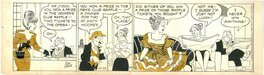
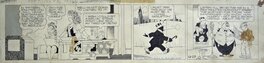
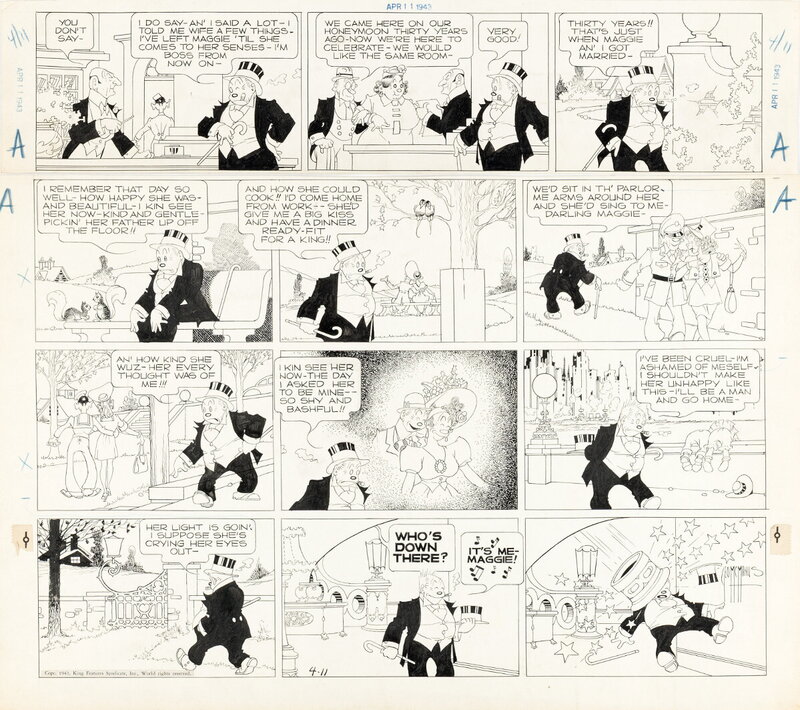
I can't help myself sometimes when it comes to certain artists. I have more than enough art by them yet I find new pieces I just can't pass on. Here is a really nice Sunday from 1943 by one of those artists, George McManus. Bringing Up Father is such a fun series with so much to like. The theme is great and I love the romantic world McManus creates only to bring Jiggs crashing back to reality. The animation and gestures of Jiggs always makes me laugh. McManus was a natural. Herge credits McManus as a big influence on his own style with Tintin. There are some really great panels in this daily from both a content and art perspective. Look at the cool art deco touches he adds to the backgrounds and that middle panel in the third tier...that should be a book cover! Unlike many of his contemporaries, McManus's humor holds up almost a century later.
2 comments
To leave a comment on that piece, please log in
About George McManus
George McManus was born of Irish parents in Saint Louis, Missouri in 1884. He dropped out of school at age fifteen and started working at the Saint Louis Republic. This newspaper published his first comic, 'Alma and Oliver'. In 1904, after winning some money, he moved to New York and was employed by the New York World. For this journal, he worked on several running stories, such as 'Snoozer', 'The Merry Marcelene', 'Panhandle Pete', 'Ready Money Ladies', 'Let George Do It', 'Cheerful Charlie' and 'Nibsby the Newsboy in Funny Fairyland'.
In 1904, McManus created 'The Newlyweds', about an elegant young couple and their baby, Snookums. This series, the first family strip in an American newspaper, became quite popular and caused rival newspaper The New York American to invite McManus to work for them, which he did from 1912 on.
He continued 'The Newlyweds', now renamed 'Their Only Child', and started up several other daily comics, like 'Rosie's Beau', 'Love Affairs of a Mutton Head', 'Spareribs and Gravy' and the famous 'Bringing Up Father'.
George McManus has influenced a great number of artists, including Hergé and Joost Swarte. With his subtle but relentless humor, he described American society, ridiculing its insatiable desire for luxury and its egotism.
Text (c) Lambiek