Dans la collection de goldgrube
Armored Trooper VOTOMS #1 – Supreme Survivor | Cover | Amerimanga
Encre de Chine
43.5 x 35.5 cm (17.13 x 13.98 in.)
Ajoutée le 02/09/2026
Lien copié dans le presse-papier !
Description
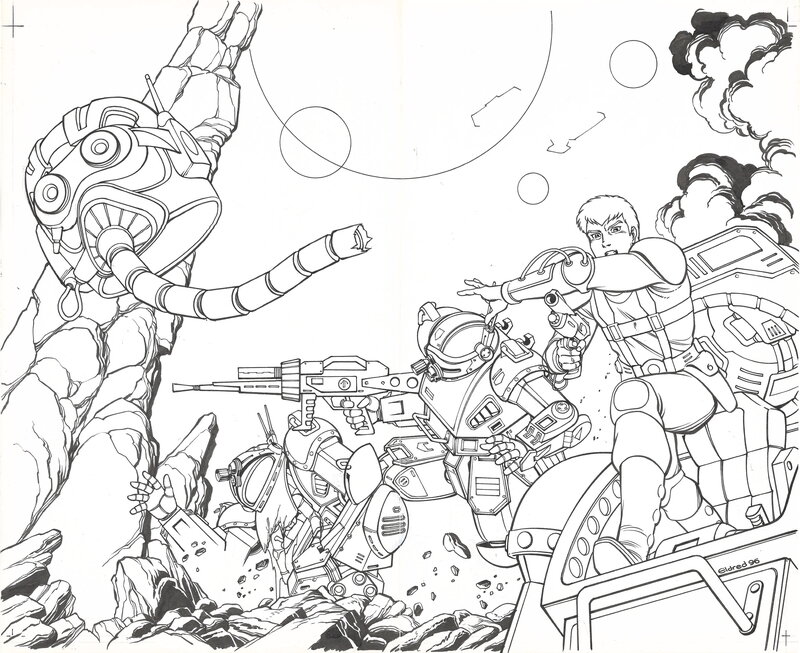
Original cover artwork for Armored Trooper VOTOMS #1: Supreme Survivor, published by Central Park Media / CPM Comics in July 1996. Art by Tim Eldred, based on Ryosuke Takahashi's Armored Trooper VOTOMS, with original mechanical designs by Kunio Okawara. First and only individually published issue of the planned four-issue American comic adaptation.
Commentaire
Armored Trooper VOTOMS occupies an important place in the history of Japanese mecha. The original 52-episode anime (1983-84), created by Ryosuke Takahashi, pushed the "real robot" concept beyond Takahashi's earlier Fang of the Sun Dougram!
Armored Troopers were not invincible super robots, but mass-produced military machines, expendable weapons used by soldiers in a brutal and remarkably grounded science-fiction universe. The mechanical designs were created by Kunio Okawara, already famous for his work on Mobile Suit Gundam.
The series quickly developed far beyond its original television run. OVAs, novels, games, model kits and other publications expanded the VOTOMS universe, while the original series was also adapted into manga by Minoru Nonaka, serialized in Comic BonBon in 1983-84.
Tim Eldred discovered the series in the 1980s and became one of its earliest and most dedicated fans. He researched the series extensively and produced his own 172-page VOTOMS Viewers Guide, helping VOTOMS reach a wider English-speaking audience and, indirectly, opening the path that would eventually allow him to work on the property officially.
Eldred had already produced comics based on Japanese anime properties including Project A-Ko, Gall Force, MD Geist and Cyber City when Central Park Media succeeded in licensing VOTOMS and gave Tim the project he had always wanted to make.
Armored Trooper VOTOMS: Supreme Survivor was produced in 1996, and Tim worked directly from the anime, extracting images from his VHS tapes and incorporating them into his layouts as visual references in order to reproduce the characters, machinery and world as accurately as possible. The drawings remained entirely his own, but the finished result stayed close to the Japanese source rather than simply reinventing it as an American comic.
The project was originally planned as a four-issue miniseries, beginning with Roots of Ambition and eventually connecting it to the beginning of the original television series.
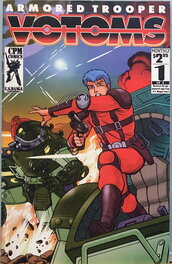
VOTOMS #1 was published in July 1996, but unfortunately, the collapse and consolidation of the American comics distribution market struck smaller publishers at precisely the wrong moment. Only the first individual issue was released. Eldred was nevertheless allowed to complete the project, and the full work appeared the following year as the Supreme Survivor graphic novel.
This original artwork is the cover of that first and only individually published issue of Armored Trooper VOTOMS.
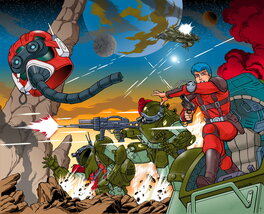
Dated 1996 and signed Eldred, the large composition brings together Chirico Cuvie and the iconic Scopedog Armored Troopers in an image conceived specifically to introduce VOTOMS to an American comic-book audience. Eldred himself describes this cover as the most elaborate single piece he had produced up to that point. Its creation involved separate artwork and effects layers for textures, gunfire, planets, bullet impacts, smoke and clouds, which were subsequently composited and colored for publication.
For Eldred, the project was quite literally the realization of a ten-year ambition. Thirty years later, Supreme Survivor remains a fascinating example of the first generation of American artists who did not simply borrow the visual language of manga and anime, but came to it first as fans, collectors and researchers, and then helped introduce those works to a Western audience.
Armored Troopers were not invincible super robots, but mass-produced military machines, expendable weapons used by soldiers in a brutal and remarkably grounded science-fiction universe. The mechanical designs were created by Kunio Okawara, already famous for his work on Mobile Suit Gundam.
The series quickly developed far beyond its original television run. OVAs, novels, games, model kits and other publications expanded the VOTOMS universe, while the original series was also adapted into manga by Minoru Nonaka, serialized in Comic BonBon in 1983-84.
Tim Eldred discovered the series in the 1980s and became one of its earliest and most dedicated fans. He researched the series extensively and produced his own 172-page VOTOMS Viewers Guide, helping VOTOMS reach a wider English-speaking audience and, indirectly, opening the path that would eventually allow him to work on the property officially.
Eldred had already produced comics based on Japanese anime properties including Project A-Ko, Gall Force, MD Geist and Cyber City when Central Park Media succeeded in licensing VOTOMS and gave Tim the project he had always wanted to make.
Armored Trooper VOTOMS: Supreme Survivor was produced in 1996, and Tim worked directly from the anime, extracting images from his VHS tapes and incorporating them into his layouts as visual references in order to reproduce the characters, machinery and world as accurately as possible. The drawings remained entirely his own, but the finished result stayed close to the Japanese source rather than simply reinventing it as an American comic.
The project was originally planned as a four-issue miniseries, beginning with Roots of Ambition and eventually connecting it to the beginning of the original television series.
VOTOMS #1 was published in July 1996, but unfortunately, the collapse and consolidation of the American comics distribution market struck smaller publishers at precisely the wrong moment. Only the first individual issue was released. Eldred was nevertheless allowed to complete the project, and the full work appeared the following year as the Supreme Survivor graphic novel.
This original artwork is the cover of that first and only individually published issue of Armored Trooper VOTOMS.
Dated 1996 and signed Eldred, the large composition brings together Chirico Cuvie and the iconic Scopedog Armored Troopers in an image conceived specifically to introduce VOTOMS to an American comic-book audience. Eldred himself describes this cover as the most elaborate single piece he had produced up to that point. Its creation involved separate artwork and effects layers for textures, gunfire, planets, bullet impacts, smoke and clouds, which were subsequently composited and colored for publication.
For Eldred, the project was quite literally the realization of a ten-year ambition. Thirty years later, Supreme Survivor remains a fascinating example of the first generation of American artists who did not simply borrow the visual language of manga and anime, but came to it first as fans, collectors and researchers, and then helped introduce those works to a Western audience.
1 commentaire
Pour laisser un commentaire sur cette œuvre, veuillez vous connecter