Dans la collection de goldgrube
Description
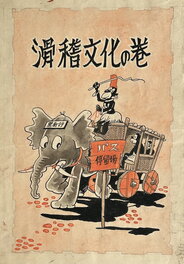
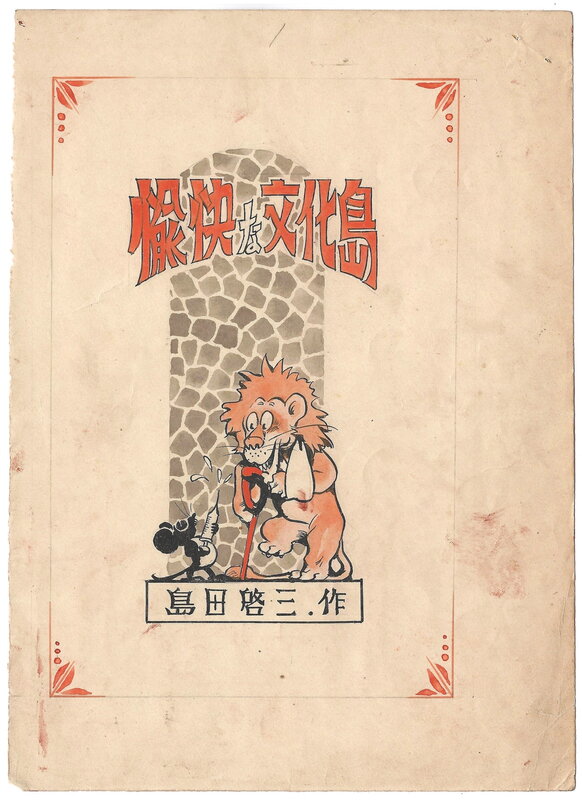
Adventurous Dankichi by Keizo Shimada originally published in Shōnen Club and reused as a title page in 'The Island of Cheerful Civilization'
Commentaire
Adventurous Dankichi (冒険ダン吉) / Bōken Dankichi by Keizo Shimada was one of the most influential works of prewar Japanese manga. First published in Shōnen Club in the 1930s, it belongs, strictly speaking, to the tradition of emonogatari, a narrative form in which text and image are presented in separate but complementary blocks.
Bōken Dankichi follows the Japanese boy Dankichi and his mouse Karikō, who fell asleep on a fishing boat and drifted to a distant southern island, where they were captured by its inhabitants. Helped by Karikō’s quick thinking, they reversed the situation, and Dankichi came to be respected as their king. Together, they set about building a “civilized” society on the island.
This setting reflects the historical context of the time. In the 1930s, Japan advanced into regions such as Micronesia in search of resources such as oil and nitrate. As a result, the “South Seas” became a subject of growing interest for children of the period.
However, from a modern perspective, Adventurous Dankichi has been criticized. It can be compared to Tintin au Congo (1931), which similarly reflects a culture in which African people were depicted in simplified and hierarchical ways. The inhabitants of the island ruled by Dankichi are portrayed through racialized caricatures, with exaggerated features, presented as naïve or subordinate, and even identified by numbers rather than names. The setting also mixes elements from different parts of the world: animals such as lions, elephants, and giraffes, foreign to the Pacific, appear on the island. The presence of a lion in the image shown here is a clear example of this.
Such elements show how children’s stories of the time could reflect and reinforce hierarchical and colonial ways of thinking. At the same time, Adventurous Dankichi remains an important work in the history of Japanese visual storytelling, illustrating both the forms that existed before modern manga and the cultural imagination that made it so popular.
In the 1950s it was transformed into a postwar-style manga, restructuring the original art and in some cases redrawing panels where necessary.
_______________________________________
A postwar edition from just before the 1950s such as 冒険ダン吉 愉快な文化島 (The Island of Cheerful Civilization), published in 1949 by Saikensha, shows how prewar material was reused, preserving the emonogatari format while introducing it to a new generation of readers. The title-page illustration featuring Karikō alongside a “Pacific” lion is a rare surviving example of Keizo Shimada’s work and a striking illustration of the visual world of prewar manga.
Bōken Dankichi follows the Japanese boy Dankichi and his mouse Karikō, who fell asleep on a fishing boat and drifted to a distant southern island, where they were captured by its inhabitants. Helped by Karikō’s quick thinking, they reversed the situation, and Dankichi came to be respected as their king. Together, they set about building a “civilized” society on the island.
This setting reflects the historical context of the time. In the 1930s, Japan advanced into regions such as Micronesia in search of resources such as oil and nitrate. As a result, the “South Seas” became a subject of growing interest for children of the period.
However, from a modern perspective, Adventurous Dankichi has been criticized. It can be compared to Tintin au Congo (1931), which similarly reflects a culture in which African people were depicted in simplified and hierarchical ways. The inhabitants of the island ruled by Dankichi are portrayed through racialized caricatures, with exaggerated features, presented as naïve or subordinate, and even identified by numbers rather than names. The setting also mixes elements from different parts of the world: animals such as lions, elephants, and giraffes, foreign to the Pacific, appear on the island. The presence of a lion in the image shown here is a clear example of this.
Such elements show how children’s stories of the time could reflect and reinforce hierarchical and colonial ways of thinking. At the same time, Adventurous Dankichi remains an important work in the history of Japanese visual storytelling, illustrating both the forms that existed before modern manga and the cultural imagination that made it so popular.
In the 1950s it was transformed into a postwar-style manga, restructuring the original art and in some cases redrawing panels where necessary.
_______________________________________
A postwar edition from just before the 1950s such as 冒険ダン吉 愉快な文化島 (The Island of Cheerful Civilization), published in 1949 by Saikensha, shows how prewar material was reused, preserving the emonogatari format while introducing it to a new generation of readers. The title-page illustration featuring Karikō alongside a “Pacific” lion is a rare surviving example of Keizo Shimada’s work and a striking illustration of the visual world of prewar manga.
2 commentaires
Pour laisser un commentaire sur cette œuvre, veuillez vous connecter