In comixfan 's collection
Comment
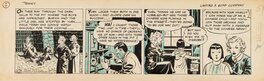
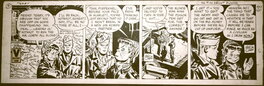
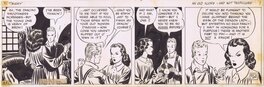
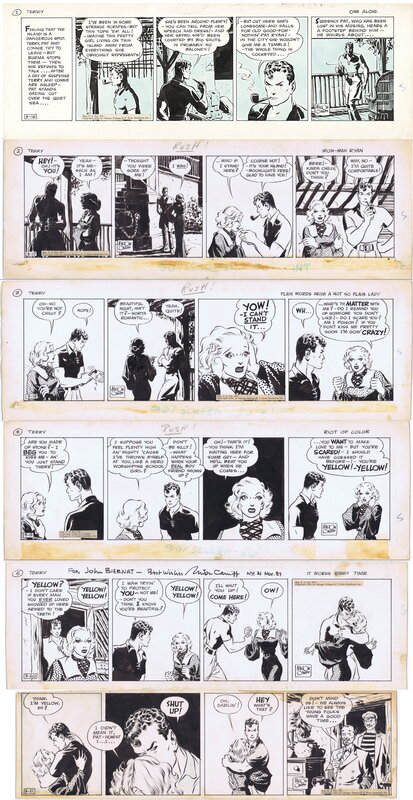
A full week of Terry dailies, Monday to Saturday. I added the Monday to this sequence last week and it seems all is right in the world (unless you turn on the news).
Terry and Pirates ran as both a daily and Sunday, so 6 dailies a week plus a 3 or 4 tier Sunday (depending on format). That is a lot of art for a single artist. At this point in his career, Caniff was sharing a studio with Noel Sickles and this is around the period they had synergy, learning from each other and evolving both their styles. There may very well be some ghosting on this by Noel. This is from March 1936, Terry had been adventuring for only a year and half now and Caniff was already a veteran comic artist at the age of 29. His style is so mature and yet would only get better and continue to evolve throughout the rest of his career. Among Caniff's greatest strengths were his storytelling and character development and it is around this time that he really got a handle on this and not just the art. Terry is a bit of a difficult read for the first 6 months but once you get past that, it is an amazing story and perhaps among the best narratives in the history of comics. I'd encourage you to consider reading it (currently available in its best reprinting of all time) if you have had enough of comics and want to explore the history of the medium and to see the artist who influenced everyone in comics after him evolve.
On that point of narratives and sequential art, I want to present to you something you don't always see, a complete week of the strip. Everyone is familiar with comic pages that are meant to be part of a story and not to stand alone. Strips are meant to stand alone and have a presence on a page filled with others competing for the reader's attention. Each is a potential page turn with something there to make a reader want to come back the following day. There is a real art to that which you don't see in comics except at perhaps at the end of a book. Here are the entire 6 days of the week presented together, at this point in the series the Sundays were still a separate story line (Also, no Sundays of this era are known to exist). I was happy to reunite this current daily with the rest of its family for the week. Take a moment and check out the content and dialogue. Although dated, it is still fun and Caniff produces one of the most famous scenes from Terry and ends in the introduction of one of the main recurring villains.
Another thing to notice in the sequence is that Caniff used the 4 panel layout throughout to great effect. Most of the panels have no background but with one background in the first panel of daily 5 Caniff moves us from outside to inside where the sequence will end.
This is done so effortlessly that we don't really even notice and that is because we are not suppose to but our mind registers it and we are not surprised to find them in an interior setting.
These dailies have had different journeys getting back to me and you can see that in the cropping and staining. The top one I have not scanned personally yet so it looks a bit different in tone. The blue wash applied to the Monday is less apparent as the week goes on, it is almost like Caniff ran out of blue that week.
The dailies I had from this sequence I got from the estate of a good friend, John Biernat who ran the Dragon Lady comic shop and the Dragon Lady Press. These were among his favorite strips and Burma was his favorite female in the series. I am glad to bring the rest of the story together and wish I could have shared it with John. He would have been beaming with happiness to see this as only John could.
Terry and Pirates ran as both a daily and Sunday, so 6 dailies a week plus a 3 or 4 tier Sunday (depending on format). That is a lot of art for a single artist. At this point in his career, Caniff was sharing a studio with Noel Sickles and this is around the period they had synergy, learning from each other and evolving both their styles. There may very well be some ghosting on this by Noel. This is from March 1936, Terry had been adventuring for only a year and half now and Caniff was already a veteran comic artist at the age of 29. His style is so mature and yet would only get better and continue to evolve throughout the rest of his career. Among Caniff's greatest strengths were his storytelling and character development and it is around this time that he really got a handle on this and not just the art. Terry is a bit of a difficult read for the first 6 months but once you get past that, it is an amazing story and perhaps among the best narratives in the history of comics. I'd encourage you to consider reading it (currently available in its best reprinting of all time) if you have had enough of comics and want to explore the history of the medium and to see the artist who influenced everyone in comics after him evolve.
On that point of narratives and sequential art, I want to present to you something you don't always see, a complete week of the strip. Everyone is familiar with comic pages that are meant to be part of a story and not to stand alone. Strips are meant to stand alone and have a presence on a page filled with others competing for the reader's attention. Each is a potential page turn with something there to make a reader want to come back the following day. There is a real art to that which you don't see in comics except at perhaps at the end of a book. Here are the entire 6 days of the week presented together, at this point in the series the Sundays were still a separate story line (Also, no Sundays of this era are known to exist). I was happy to reunite this current daily with the rest of its family for the week. Take a moment and check out the content and dialogue. Although dated, it is still fun and Caniff produces one of the most famous scenes from Terry and ends in the introduction of one of the main recurring villains.
Another thing to notice in the sequence is that Caniff used the 4 panel layout throughout to great effect. Most of the panels have no background but with one background in the first panel of daily 5 Caniff moves us from outside to inside where the sequence will end.
This is done so effortlessly that we don't really even notice and that is because we are not suppose to but our mind registers it and we are not surprised to find them in an interior setting.
These dailies have had different journeys getting back to me and you can see that in the cropping and staining. The top one I have not scanned personally yet so it looks a bit different in tone. The blue wash applied to the Monday is less apparent as the week goes on, it is almost like Caniff ran out of blue that week.
The dailies I had from this sequence I got from the estate of a good friend, John Biernat who ran the Dragon Lady comic shop and the Dragon Lady Press. These were among his favorite strips and Burma was his favorite female in the series. I am glad to bring the rest of the story together and wish I could have shared it with John. He would have been beaming with happiness to see this as only John could.
7 comments
To leave a comment on that piece, please log in
About Milton Caniff
Milton Arthur Paul Caniff is an American comic strip artist best known for his comic strips Terry and the Pirates and Steve Canyon. He is considered a master of black and white. He was the fourth author to be added to the Will Eisner Award Hall of Fame in 1988.